
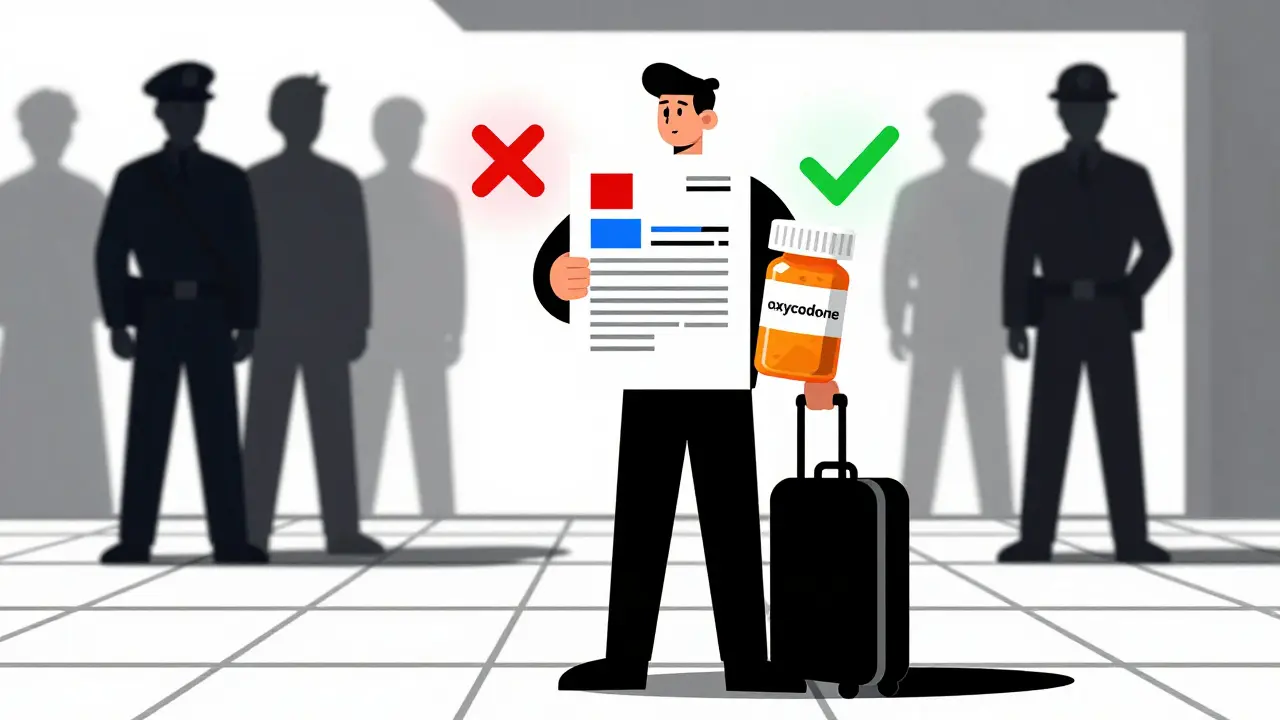
If you’re flying overseas and take medication like oxycodone, Adderall, Xanax, or any other controlled substance, you’re not just packing pills-you’re carrying legal paperwork that could make or break your trip. One wrong move at customs, and you could face detention, fines, or even jail-even if your meds are perfectly legal at home. This isn’t scare tactics. In 2022, the International Narcotics Control Board documented 127 cases where travelers were held for an average of 14 days just because their doctor’s letter was missing key details. You don’t need to be a criminal to get caught. You just need to be unprepared.
Why a Doctor’s Letter Isn’t Optional
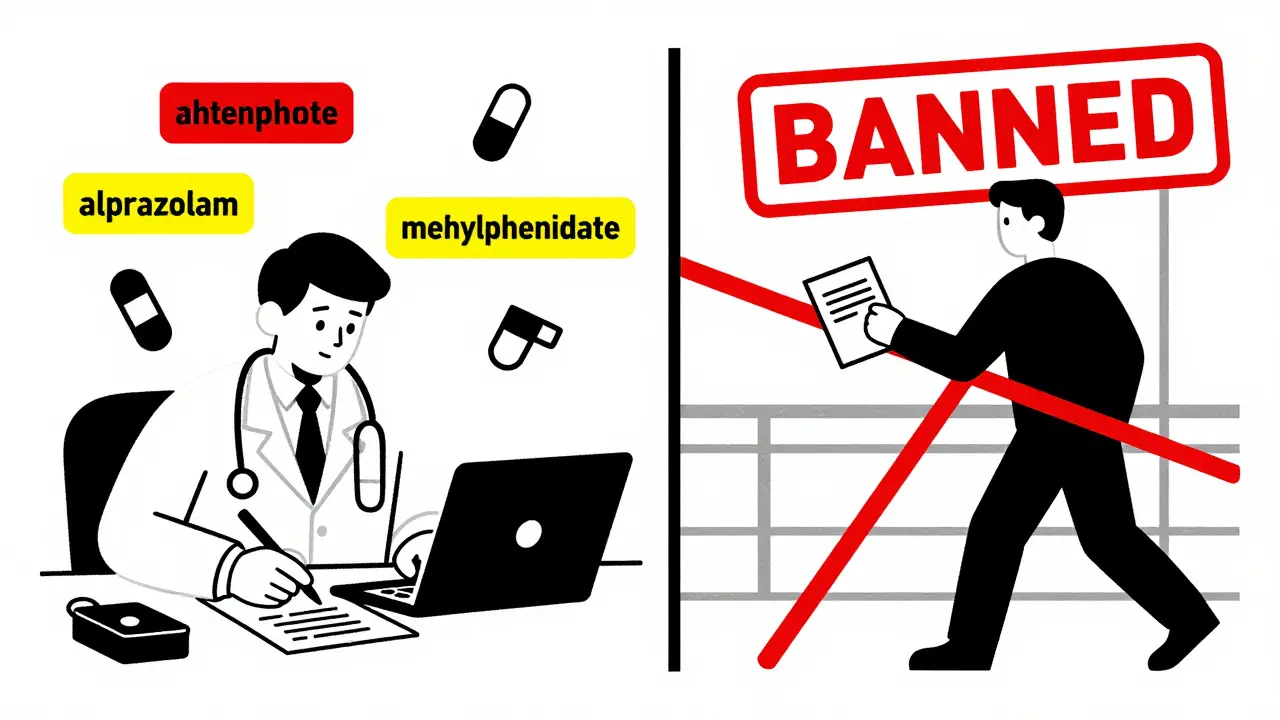
Every country that signed the 1961 Single Convention on Narcotic Drugs agrees to control certain drugs. That’s 186 countries. But they also agree to let travelers bring in small amounts for personal medical use-if they can prove it. That proof? A doctor’s letter. Not a prescription. Not a note on a napkin. A formal, signed, letterhead document that meets international standards.The problem? Most doctors don’t know what to put in it. The CDC’s 2023 Yellow Book template shows the exact elements required: full patient name and date of birth, doctor’s name, title, and contact info, and most importantly-the generic name of the drug. Not the brand. Not the color of the pill. The chemical name. For example: amphetamine, not Adderall. alprazolam, not Xanax. oxycodone, not OxyContin.
Why does this matter? Because Adderall doesn’t exist in Japan. Xanax is banned in the UAE. Oxycodone requires special approval in Singapore. Your pill might be legal in the U.S., but the active ingredient is still regulated abroad. If your letter says "Adderall" and you land in Tokyo, you’re out of luck-even if you have a 90-day supply and a valid U.S. prescription.
What Goes in the Letter
Your doctor’s letter must include these six things, no exceptions:- Your full legal name and date of birth (must match your passport exactly)
- Doctor’s full name, license number, clinic address, phone, and email
- Exact generic name of each medication (e.g., methylphenidate, not Ritalin)
- Dosage, frequency, and route (e.g., 20 mg once daily, oral)
- Clear statement: "This patient requires this medication for the treatment of [condition]" (e.g., ADHD, chronic pain, anxiety)
- Official letterhead, original signature, and date
And here’s the kicker: the DEA says for Schedule II drugs (like Adderall, oxycodone, fentanyl), you must also carry the original prescription with you. The letter alone isn’t enough. You need both.
How Much Can You Bring?
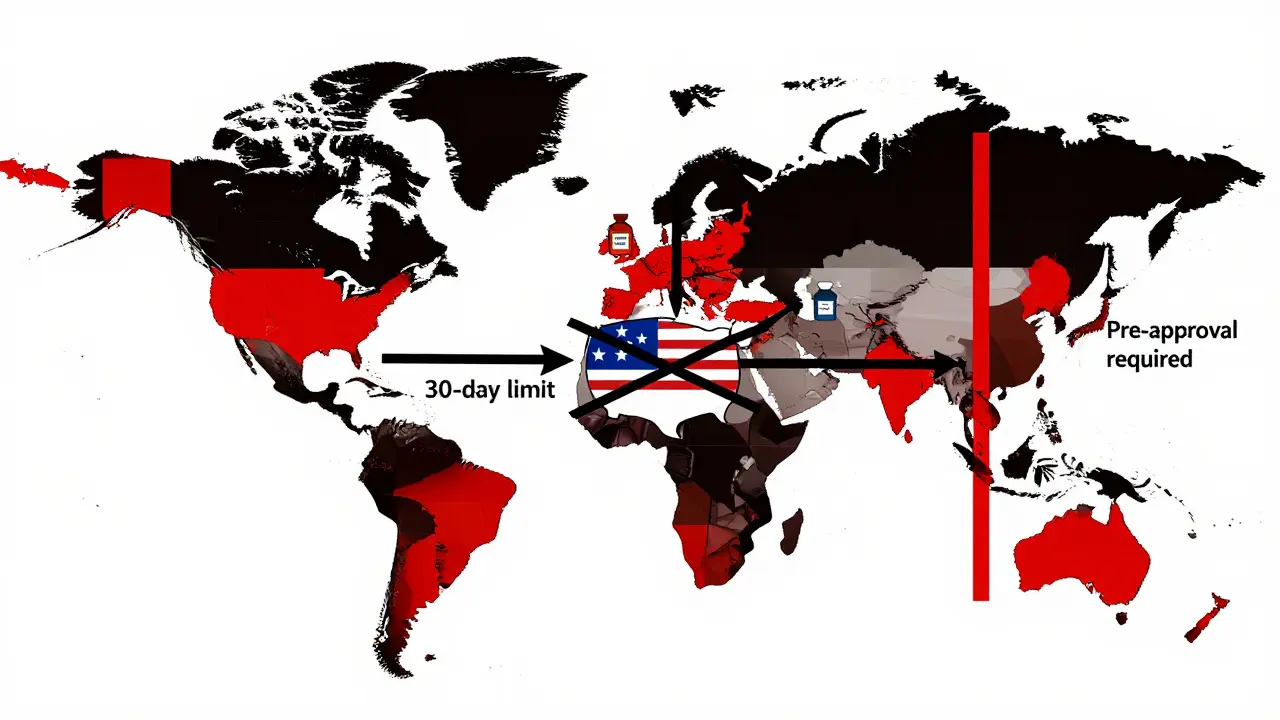
The FDA and CBP say: no more than a 90-day supply. That’s the golden rule. Most countries accept this. Some don’t.Japan allows only a 30-day supply-even with perfect documentation. Singapore and Malaysia treat anything over 30 days as trafficking. The UAE requires you to apply for permission before you fly. Canada accepts up to 100 dosage units without a letter if it’s a Schedule I or II drug. The EU generally follows the 90-day rule if your letter is in English or translated.
Don’t assume your country’s rules apply everywhere. A 90-day supply in the U.S. might be legal. In Thailand? It’s a felony. Always check the destination country’s official health or customs website. The U.S. State Department reports 58% of travelers use outdated or wrong info from blogs or forums. Don’t be one of them.
How to Store Your Medications
Keep your pills in their original bottles. Always. The label must match the name on your letter and prescription. If you need to use a pill organizer for daily doses, bring the original bottles along with you. Customs officers will compare them.Don’t pack them in checked luggage. Keep them in your carry-on. If your bag gets lost, you still have your meds-and your paperwork. And never mix medications from different prescriptions in one container. Each controlled substance needs its own letter and its own bottle.
Electronic prescriptions? The FDA says they’re acceptable if they’re printed and signed by your doctor. But if you’re flying to a country with strict controls, stick to paper. Avoid gray areas.
Country-Specific Traps
Some countries are easy. Others? Not so much.- Japan: Adderall, Ritalin, and most ADHD meds are illegal-even with a letter. You can’t bring them. Period. If you need stimulants, talk to a local doctor upon arrival.
- United Arab Emirates: You must apply for advance approval from the Ministry of Health. This can take 4-6 weeks. Don’t wait until the airport.
- Singapore and Malaysia: Over 30 days’ supply = criminal offense. Even if you have a letter, you’re risking jail.
- Thailand: Benzodiazepines like Xanax and Valium are strictly controlled. A letter helps, but you still need to declare them at customs.
- United States: You need a letter AND the original prescription. CBP officers will ask for both.
And if you’re traveling to multiple countries? You need a separate letter for each controlled substance, and you need to check each country’s rules individually. There’s no global pass.
What to Do Before You Go
Start two months before your trip. Here’s your checklist:- Make a full list of every medication you take, including over-the-counter drugs and supplements. Some countries regulate things like pseudoephedrine or melatonin.
- Call your doctor’s office. Ask them to write a letter using the CDC’s template. If they don’t know what that is, send them the link. Most don’t know.
- Verify the generic names of your meds. Use Drugs.com or the NIH’s DailyMed database to confirm.
- Check each country’s official health ministry or customs website. Don’t rely on travel blogs.
- Print two copies of your letter and prescription. Keep one in your carry-on, one in your wallet.
- Call the embassy of your destination country. Ask: "What are the rules for bringing [generic drug name] into your country?" Record their answer.
Pro tip: If you’re taking ADHD medication, you’re in the highest-risk group. 89% of countries require special documentation for stimulants. Don’t assume you’re safe just because you’ve flown before.
What Happens If You Get Stopped?
If customs asks about your meds:- Stay calm. Don’t argue.
- Hand over your letter and prescription immediately.
- Don’t say "It’s just for my anxiety" or "I’ve been taking it for years." Stick to facts.
- If they ask for more, ask to speak to a supervisor.
Most incidents are resolved quickly if you have the right documents. The real danger is when people try to hide meds or lie. That’s what turns a misunderstanding into a legal nightmare.
What’s Changing in 2025
The INCB is rolling out a digital medical certificate pilot in 12 European countries. By 2025, the EU plans to have a unified system where your doctor’s letter can be verified electronically. But until then? Paper still rules.Meanwhile, 28 countries tightened their rules in 2022 alone. The trend is clear: more restrictions, not fewer. The days of flying with a bottle of pills and a smile are over. If you rely on controlled substances, you now have to treat your meds like a passport.
Frequently Asked Questions
Do I need a doctor’s letter for over-the-counter meds?
Yes, if they contain controlled ingredients. Pseudoephedrine (in some cold meds), codeine (in some cough syrups), and even high-dose melatonin are regulated in some countries. Always check the active ingredient, not just the brand name.
Can my telehealth doctor write the letter?
Yes, if they’re licensed in your state and can print on official letterhead. The FDA accepts telehealth prescriptions as long as they’re signed and include all required info. But some countries still prefer letters from doctors you’ve seen in person. When in doubt, call the embassy.
What if my medication isn’t available in the country I’m visiting?
Don’t assume you can refill it there. Many countries don’t stock U.S. brands or even generics. Bring your full supply. If you’re staying long-term, contact a local doctor before you go. Some will prescribe alternatives, but only after reviewing your records.
Can I mail my meds ahead of time?
Almost never. International shipping of controlled substances is illegal without a special license. Even pharmacies can’t do it. Always carry your meds with you in your carry-on.
Do children need separate letters?
Yes. Each person carrying controlled substances needs their own letter-even infants on liquid medication. Include the child’s full name, date of birth, and the parent or guardian’s name as the authorized carrier.
Final Advice
This isn’t about bureaucracy. It’s about safety-for you and others. The system exists because people have been arrested for carrying pills they thought were harmless. The rules are strict, but they’re clear. If you follow them, you’ll fly without stress. If you don’t, you could lose your trip, your freedom, or worse.Two months before you leave, sit down with your doctor. Print the letter. Check each country’s rules. Pack your meds right. You’ve done the hard part-managing your health. Don’t let a missing signature ruin your journey.

Linda Caldwell
December 16, 2025 AT 14:08Just packed my Adderall for Tokyo and skipped the letter-worst decision ever. Got detained for 12 hours. Now I know.
Anna Giakoumakatou
December 16, 2025 AT 22:54Oh, so now we’re treating medication like a VIP pass to the global elite? How quaint. Next they’ll require a handwritten sonnet explaining why you need ibuprofen. The real crime is that your doctor has to be a legal scholar just to keep you alive abroad.
CAROL MUTISO
December 17, 2025 AT 19:08I love how this post reads like a survival guide for the pharmacologically privileged. Honestly? It’s tragic that we live in a world where your anxiety meds are treated like contraband. I once had to explain to a customs officer in Dubai why alprazolam wasn’t ‘narcotic theater’-he asked if it was a ‘spiritual enhancer.’ I didn’t laugh. I cried inside.
Pro tip: print two copies. Tape one to your passport. The other? Put it in your bra. Not for drama-because when they search you, they’ll look everywhere except where the truth is hiding.
Erik J
December 18, 2025 AT 08:44Interesting that the CDC template requires the generic name. I wonder how many doctors actually know the difference between brand and generic. My neurologist called it ‘the blue pill’ for six months before I corrected him.
Also, does anyone know if the INCB digital pilot includes non-EU countries? Or is this just another EU-centric solution?
BETH VON KAUFFMANN
December 19, 2025 AT 23:34Let’s be real: this entire framework is a regulatory dumpster fire. You need a letter? Fine. But why is the DEA still treating Schedule II as if we’re in 1970? And why does Singapore think 30 days is ‘trafficking’ but 31 is ‘a felony with mandatory minimums’? It’s not logic-it’s bureaucratic performance art.
Also, ‘original prescription’? So if I lose it? Do I get deported? Or just a sternly worded email from CBP?
Martin Spedding
December 21, 2025 AT 17:43OMG i just got back from thailand and they asked for my letter and i had it but the doc used ‘xanax’ not ‘alprazolam’ and they almost took me to jail lmao. 10/10 would get arrested again.
Raven C
December 22, 2025 AT 20:05It is, without a doubt, a profound failure of the modern medical-industrial complex that one must carry notarized, letterhead-certified, federally compliant documentation to ingest a substance that was prescribed to them by a licensed professional-in their own country. The irony is not lost on me that we have more stringent controls over pharmaceuticals than we do over firearms.
And yet, we are expected to be grateful for the privilege of being allowed to exist in a medically stable state while traveling.
Donna Packard
December 23, 2025 AT 00:43This is such a helpful guide-I’ve never felt more prepared for international travel. Thank you for taking the time to lay this out so clearly. You’ve saved someone from a nightmare.
Patrick A. Ck. Trip
December 24, 2025 AT 19:22Thank you for this comprehensive overview. I am deeply appreciative of the diligence required to navigate international pharmaceutical regulations. I have printed two copies of the CDC template and will ensure my physician signs it on official letterhead. I also intend to contact the embassy of each destination to confirm compliance. This is not merely bureaucratic-it is an act of personal responsibility.
Sam Clark
December 25, 2025 AT 16:56One thing people overlook: if you’re traveling with a child on liquid methylphenidate, make sure the bottle has the pharmacy label AND the doctor’s letter lists the child’s full legal name. I once had a border agent question why a 4-year-old needed ‘stimulants’-until I showed the letter. He apologized. The system works if you’re prepared.
Jessica Salgado
December 27, 2025 AT 12:16I had to fly to Singapore with my oxycodone and I was terrified. I printed the letter, carried the prescription, had the original bottles, and still had a 45-minute interrogation. The officer said, ‘You’re lucky you didn’t die in the airport.’ I didn’t know whether to laugh or cry. But I’m alive. And I’m not going anywhere without this again.
Jonathan Morris
December 27, 2025 AT 15:22Who wrote this? The DEA? The UN? Or is this just a psyop to get people to panic about their meds? Did you know the INCB is funded by pharmaceutical giants? This whole ‘letter’ thing is designed to make you dependent on the system. They want you to beg for permission to be healthy. Wake up.
Pawan Chaudhary
December 28, 2025 AT 13:29Hey this is super useful! I’m from India and I take my ADHD meds to the US every year. Never knew about the generic name thing. Thanks for the heads up. God bless you all!
Marie Mee
December 29, 2025 AT 16:36They’re watching us. They know what pills we take. They’re building a database. Next they’ll track your antidepressants via your phone. I’m not bringing anything. I’m going bare. Let them try to stop me.
Naomi Lopez
December 31, 2025 AT 13:33Wow. The fact that your doctor has to be a legal technician just to let you breathe normally while traveling is a testament to the collapse of human dignity in healthcare. Also, ‘alprazolam’? That’s not a word. That’s a spell. Who even says that?