
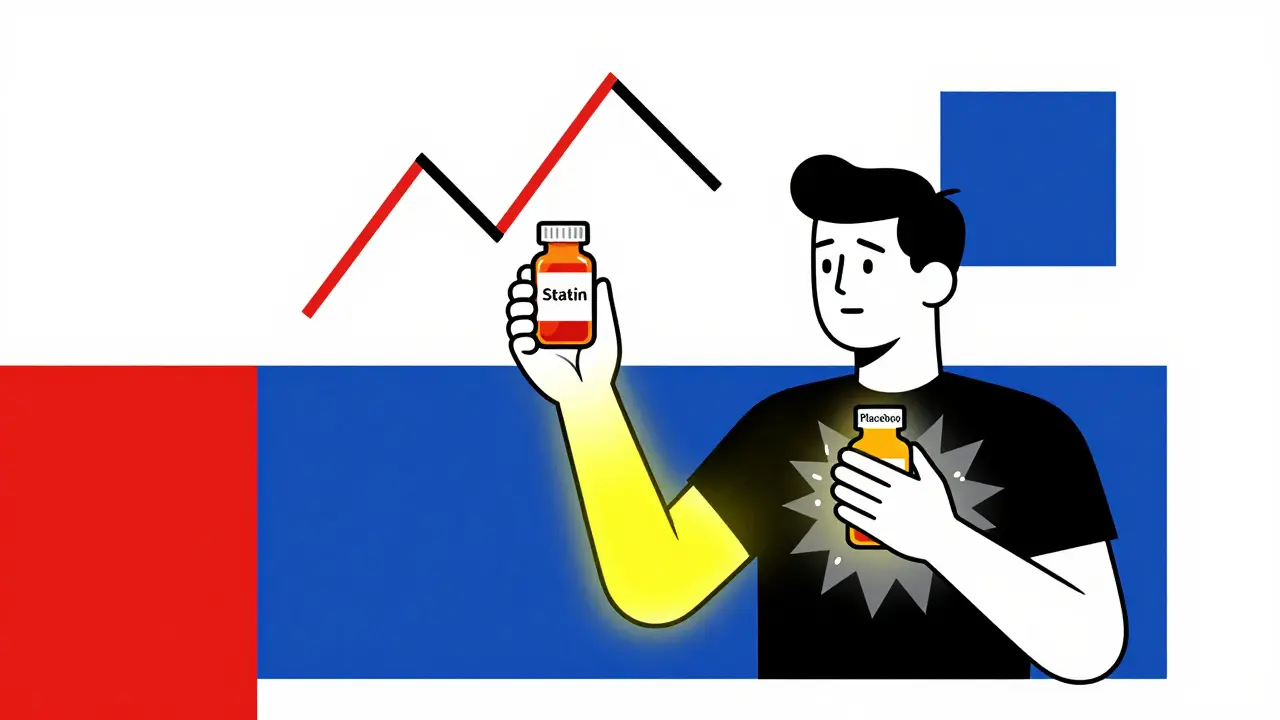
Statin Side Effect Assessment Tool
Assess Your Symptoms
This tool helps determine if your symptoms are likely due to the nocebo effect or real statin side effects based on SAMSON trial research.
Your Results
According to SAMSON trial research (2021), 90% of statin side effects are likely due to the nocebo effect. This means your symptoms may not be caused by the medication itself, but by your expectations.
Millions of people take statins every year to lower their cholesterol and reduce the risk of heart attacks and strokes. But for a lot of them, the medication doesn’t last long. Why? Because they stop taking it-often due to muscle pain, fatigue, or weakness. Many assume these symptoms are caused by the statin itself. But what if they’re not? What if the real culprit isn’t the drug, but the nocebo effect?
What Is the Nocebo Effect?
The nocebo effect is the dark twin of the placebo effect. Placebo effect? That’s when you feel better because you believe a treatment will help-even if it’s just a sugar pill. Nocebo effect? That’s when you feel worse because you expect side effects-even if you’re not even taking the real drug. It’s not just in your head. The symptoms are real. Muscle aches, nausea, tiredness-they hurt. But the trigger isn’t the chemistry of the pill. It’s your expectation. You read about statin side effects online. A friend says they couldn’t tolerate it. Your doctor mentions muscle pain as a possible risk. Suddenly, your body starts looking for those symptoms. And when you feel them, you think: It’s the statin.The SAMSON Trial: A Game-Changer
In 2021, a landmark study called SAMSON changed how doctors think about statin side effects. Led by James Philip Howard at Imperial College London, it followed 60 people who had quit statins because of side effects. These weren’t people who just felt a little off-they were so convinced the drug was harming them that they stopped cold. Here’s how the trial worked: Each person got 12 bottles over 12 months. Four had atorvastatin (the real drug). Four had dummy pills (placebo). Four were empty-no pills at all. They didn’t know which was which. Every day, they used a phone app to rate their symptoms on a scale from 0 to 100. The results were shocking. When people took the real statin, their symptom score averaged 16.3. When they took the placebo? 15.4. When they took nothing? Just 8.0. That means the symptoms they blamed on statins were just as bad-or even worse-when they were taking a sugar pill. And when they took nothing? Symptoms dropped by nearly half. The nocebo ratio? 0.90. That means 90% of the symptoms people blamed on statins were actually happening even without the drug. The timing was identical too. Symptoms showed up within days of starting any pill-real or fake-and faded just as fast when they stopped. That’s not how real drug side effects behave. Real ones usually build up slowly or linger after stopping. These didn’t.Why Do Statins Trigger This More Than Other Drugs?
Statins are uniquely vulnerable to the nocebo effect. Why? Because they’re talked about more. You see headlines: “Statin Side Effects: The Hidden Danger.” You get brochures listing muscle pain, diabetes risk, memory issues. The FDA warning labels are long. Online forums are full of horror stories. Compare that to blood pressure pills or even diabetes meds. No one talks about their side effects the same way. So when someone starts a statin, their brain is already primed to notice any twinge in their leg, any extra fatigue. They interpret it as proof the drug is harming them. A 2021 meta-analysis of over 18,000 people in blinded trials found no difference in muscle symptoms between statin and placebo groups. But in real-world, non-blinded studies? Up to 20% of patients report muscle pain. That gap? It’s the nocebo effect in action.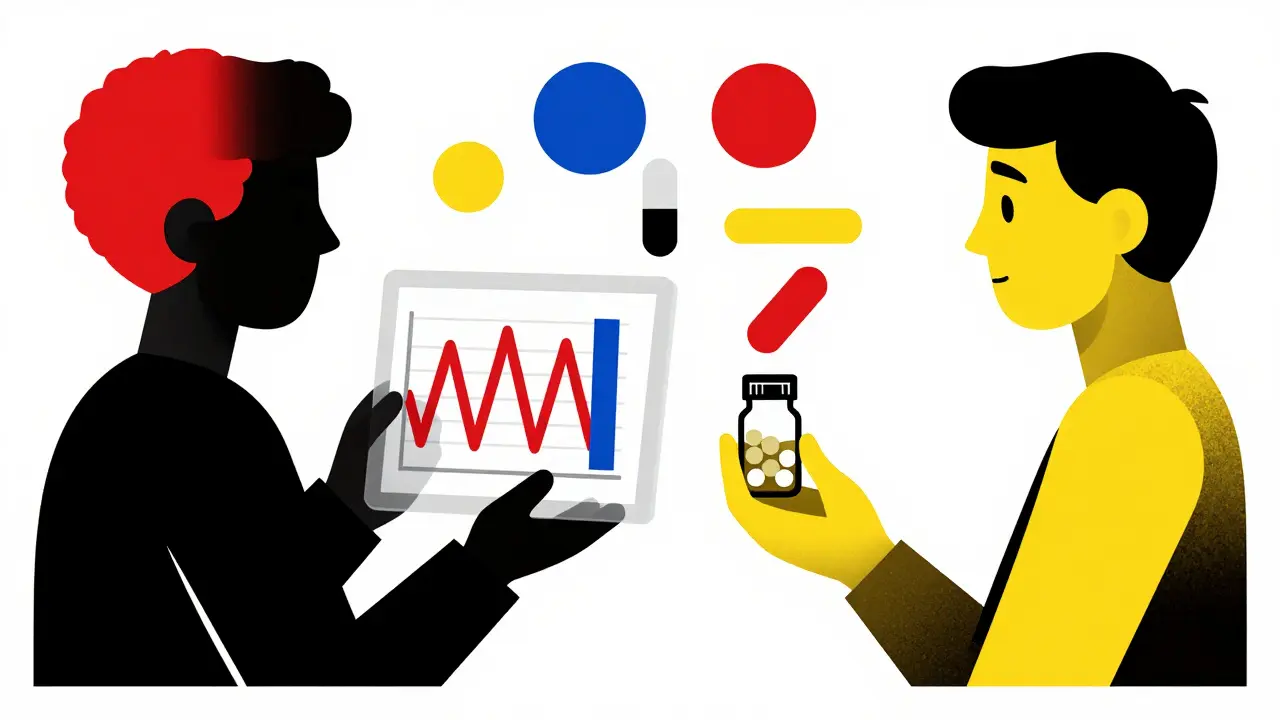
Real People, Real Results
After the SAMSON trial, something surprising happened. Half the participants restarted statins. Why? Because they saw their own data. They saw that their symptoms were just as bad on the placebo. They saw that when they took nothing, they felt better. That wasn’t just theory-it was personal proof. One Reddit user wrote: “After seeing my symptom scores were identical on placebo and statin, I restarted atorvastatin and have been symptom-free for 6 months.” Another shared: “I thought I was allergic to statins. Turns out, I was allergic to the idea of them.” Clinicians who used SAMSON’s method-showing patients their own symptom graphs-saw statin restart rates jump from 22% to nearly 50%. That’s not magic. That’s evidence.What About Real Side Effects?
This isn’t about dismissing pain. It’s about separating real problems from false alarms. True statin side effects? They’re rare. Muscle damage (myopathy) happens in about 5 out of every 100 people. Rhabdomyolysis-the most severe form-is rarer than being struck by lightning: fewer than 1 case per million people per year. If you have extreme muscle pain, dark urine, or your CPK levels are way above normal, that’s not nocebo. That’s real. And you need help. But if your symptoms are mild, come and go, and show up only when you think you’re taking the pill? That’s likely the nocebo effect. And that’s fixable.What Can You Do If You Stopped Statins?
You don’t have to live without statins. Here’s how to test it safely:- Ask your doctor about a nocebo challenge. You can do it with just two visits and a phone app.
- Track your symptoms daily-even if you think it’s pointless. Numbers don’t lie.
- Start with a low dose. Try 5mg of rosuvastatin or 10mg of atorvastatin. Less drug = less chance of triggering anxiety.
- Give it time. Symptoms from nocebo usually fade after 2-4 weeks as your brain adjusts.
- Don’t read side effect lists right before taking the pill. It primes your brain for trouble.
How Doctors Are Changing Their Approach
Cardiologists are no longer just saying, “Just push through the pain.” They’re showing patients their own data. They’re using visual graphs to prove that symptoms match placebo, not drug. The American College of Cardiology now recommends nocebo education as part of standard care for statin-intolerant patients. The European Atherosclerosis Society has created a simple script for doctors: “Your symptoms are real. But 90% of them happen even without the drug. Let’s look at your numbers.” Pfizer, Amgen, and other drugmakers now include nocebo education in their patient support programs. Apple and Google are partnering with universities to build symptom trackers into Health and Fit apps.Why This Matters for Your Heart
Stopping statins because of perceived side effects isn’t just inconvenient. It’s dangerous. Over 50% of the heart protection statins offer is lost when people quit. That’s not just a number. It’s more heart attacks, more strokes, more deaths. The U.S. loses $11.2 billion a year because people stop statins based on false beliefs. That’s $11.2 billion in hospital bills, emergency visits, and lost productivity-all avoidable. If you’re one of the 40-70% who quit statins, you’re not weak. You’re not crazy. You’re caught in a powerful psychological trap. But now you know how to break free.Final Thought: The Pill Isn’t the Problem. The Fear Is.
Statin side effects are real. But most of them aren’t caused by the drug. They’re caused by the story you’ve been told about it. The nocebo effect doesn’t make your pain less real. It just changes what you do about it. You don’t need to suffer through a drug that doesn’t agree with you. But you also don’t need to give up the best tool we have to keep your heart alive. Your symptoms might not be from the pill. But your decision to restart it? That’s all yours.Are statin side effects real or just in my head?
The symptoms are real-muscle pain, fatigue, and nausea are genuine physical experiences. But research shows that 90% of these symptoms occur just as often when people take a placebo, not the actual statin. This means the cause is often psychological, not pharmacological. That doesn’t mean the pain isn’t real-it means it’s being triggered by expectation, not the drug’s chemistry.
Can I restart statins after stopping them?
Yes, and many people do successfully. Studies like SAMSON show that about half of patients who stopped statins due to side effects were able to restart them after seeing their own symptom data. Starting with a low dose, tracking symptoms daily, and avoiding negative online content can help. Most people find symptoms fade within a few weeks as their brain adjusts.
How do I know if my symptoms are from the nocebo effect or a real reaction?
Real statin side effects usually appear gradually, get worse over time, and don’t improve quickly after stopping. Nocebo symptoms tend to show up within days of starting the pill, match the timing of placebo use, and disappear just as fast when you stop. If you have dark urine, extreme weakness, or a CPK level over 10 times normal, that’s likely a real reaction. Otherwise, tracking symptoms with a daily app can reveal patterns that point to nocebo.
Is the nocebo effect only for statins?
No, the nocebo effect happens with many medications. But statins are uniquely affected because they’re widely prescribed, heavily discussed in media, and their side effects are well-publicized. This makes people more likely to notice and attribute normal aches and fatigue to the drug. Other medications don’t carry the same level of public anxiety, so the nocebo effect is less noticeable.
Should I stop taking statins if I feel side effects?
Don’t stop without talking to your doctor. Many side effects are due to the nocebo effect and can be managed. Your doctor can help you track symptoms, try a lower dose, switch to a different statin, or run a simple test to see if the symptoms are truly drug-related. Stopping statins without a plan increases your risk of heart attack or stroke by up to 50%.
Can I use a phone app to track my symptoms?
Yes, and it’s one of the most effective tools. The SAMSON trial used a smartphone app to record daily symptom scores on a 0-100 scale. This removed memory bias and showed clear patterns. Apps like Apple Health or Google Fit can now be paired with tools developed by academic centers to track statin symptoms. Writing down how you feel each day helps you-and your doctor-see if symptoms are tied to the pill or just coincidence.

Ademola Madehin
December 23, 2025 AT 01:21Bro, I took statins for 3 months and felt like a zombie. My legs hurt, I couldn’t get out of bed, and my brain felt like mush. Then I stopped and boom - I was alive again. Don’t tell me it’s all in my head. I’m not crazy, I’m just not dumb enough to take poison.
bharath vinay
December 24, 2025 AT 10:3190% nocebo? LOL. Big Pharma doesn’t want you to know this, but statins are just a profit machine. They’ve been pushing this narrative for years to keep you hooked. The real side effects? They bury the data. My cousin died from rhabdo after being told it was ‘just anxiety.’
suhani mathur
December 25, 2025 AT 08:40Interesting. But let’s be real - if your doctor just hands you a pill and says ‘take it,’ of course you’re gonna panic. No one explains the nocebo effect upfront. It’s not the drug, it’s the delivery.
Aurora Daisy
December 25, 2025 AT 21:52So what you’re saying is… if I believe I’m allergic to broccoli, then broccoli is the problem? Brilliant. Let’s just stop blaming drugs and start blaming people for being too emotional. Classic British logic.
Andrea Di Candia
December 27, 2025 AT 05:38This is actually beautiful. It’s not about denying pain - it’s about understanding its source. The body doesn’t lie, but our minds? They’re storytellers. If we can reframe the story, we can change the outcome. That’s not magic. That’s neuroscience.
Sidra Khan
December 27, 2025 AT 21:10So I’m supposed to trust a study where people took placebo pills and felt the same pain… but not trust my own body? Yeah, right. I’ll stick with my gut. Also, why is Apple involved? Are they selling statin trackers now? 😒
Jeffrey Frye
December 29, 2025 AT 17:56statins r a scam. i read on reddit that they cause alzheimers and make you gain weight. also, the study was funded by pfizer. duh. i dont need graphs to know my legs hurt.
Isaac Bonillo Alcaina
December 30, 2025 AT 15:13Let’s be precise: the SAMSON trial had a sample size of 60. That’s not a population. That’s a focus group. The 90% nocebo ratio is statistically meaningless when applied to millions. Also, your ‘real side effects’ threshold is laughably vague - ‘dark urine’? That’s not a diagnostic criterion, it’s a symptom. You’re conflating correlation with causation. And you call this science?
Pankaj Chaudhary IPS
January 1, 2026 AT 07:28As a medical professional in India, I’ve seen this firsthand. Patients stop statins because of fear, not symptoms. We now use simple symptom journals - handwritten, no apps needed - and show them patterns. Over 60% restart within 3 months. The key isn’t more data - it’s trust. Trust in the doctor, trust in the process. And trust that their pain is real, even if the trigger isn’t the pill.
Joe Jeter
January 2, 2026 AT 22:47Oh great. So now if I feel sick after eating gluten, it’s just my ‘expectation’? What’s next? ‘Your broken leg is just in your head because you thought you fell.’ This isn’t psychology - it’s gaslighting dressed up as science.
Wilton Holliday
January 3, 2026 AT 22:27Hey - if you’re reading this and you’re scared to restart statins, you’re not alone. I was too. But I tracked my symptoms for 4 weeks with the app. Turns out, my ‘statin pain’ was worse on days I didn’t take anything. I started low-dose rosuvastatin. Week 3? I felt better than I had in years. You don’t have to suffer. You just have to be patient - and curious.
Usha Sundar
January 4, 2026 AT 19:01My mom took statins. Got tired. Stopped. Lived longer. End of story.
Lu Jelonek
January 6, 2026 AT 18:28One thing I’ve learned as a nurse: people don’t stop statins because they’re lazy. They stop because they’re scared - and no one ever told them this could be psychological. The real breakthrough isn’t the study. It’s the doctor who says, ‘I believe you. Let’s figure this out together.’ That’s the medicine that heals.