
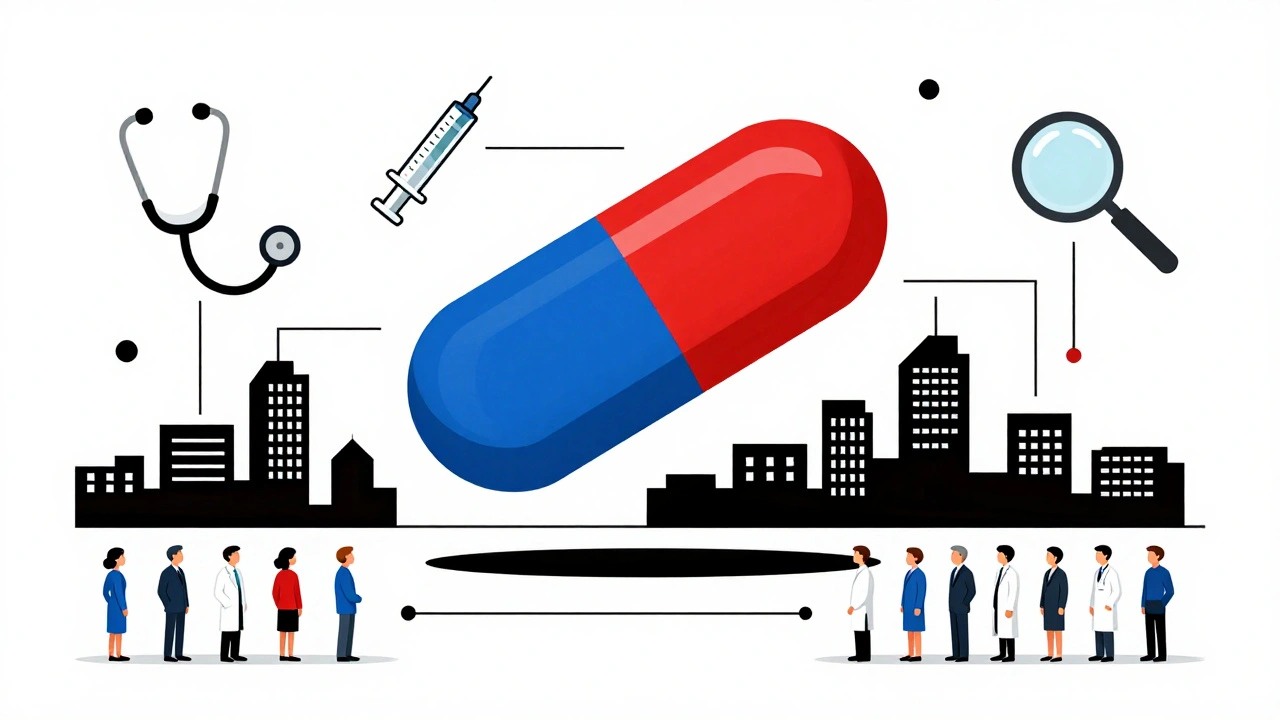
When you pick up a generic pill at the pharmacy, you expect it to work just like the brand-name version. But how does the FDA know it’s still safe and effective months or years after it hits the shelf? Unlike new drugs, generics don’t go through years of clinical trials. They’re approved based on proving they’re bioequivalent-meaning they deliver the same amount of active ingredient at the same rate as the original. That’s efficient. But it also means the real test comes after approval. This is where post-market surveillance steps in.
Why Post-Market Surveillance Matters for Generics
Over 90% of prescriptions in the U.S. are filled with generic drugs. That’s more than 3 billion prescriptions a year. These drugs save patients and the healthcare system billions. But because they’re approved based on bioequivalence-not full clinical trials-the FDA can’t predict every possible side effect or interaction before they’re widely used. Some issues only show up when thousands, even millions, of people take the drug daily. A rare heart rhythm problem. A new skin reaction. A drop in effectiveness in certain patients. These aren’t caught in trials of a few thousand people. They’re found through what happens in the real world.
The FDA doesn’t just approve generics and walk away. It has to keep watching. That’s post-market surveillance: a continuous, active system to catch problems that slipped through the cracks during approval.
How the FDA Tracks Problems After Approval
The FDA uses several tools to monitor generic drugs once they’re on the market. The biggest one is the FDA Adverse Event Reporting System (FAERS). This is a database where doctors, pharmacists, patients, and drug companies report unexpected side effects, medication errors, or product failures. If a lot of people report the same issue-say, dizziness after switching to a new generic version of a blood pressure pill-the FDA takes notice. They don’t assume the drug caused it right away. But they dig deeper.
Another key system is the Sentinel Initiative. Launched in 2008 and expanded over time, Sentinel uses real-world data from insurance claims and electronic health records from over 200 million Americans. It doesn’t rely on people remembering to report an issue. Instead, it automatically scans patterns-like a sudden spike in hospital visits for kidney problems among patients taking a specific generic version of a diuretic. This lets the FDA spot signals faster than waiting for reports to pile up.
The FDA also runs MedWatch, a program that lets anyone-patients, caregivers, healthcare workers-report problems directly. You don’t need to be a doctor. If you notice your generic seizure medication isn’t controlling your seizures like it used to, or you get a rash you didn’t have before, you can file a report. These reports matter. In 2019, a JAMA Internal Medicine study found that about 15% of adverse event reports for generics involved complaints about perceived differences in effectiveness compared to brand-name drugs. The FDA doesn’t dismiss these. They investigate whether it’s a real pharmacological difference or something else, like the nocebo effect-where patients expect to feel worse after switching and actually do.
Manufacturing Checks: More Than Just the Pill
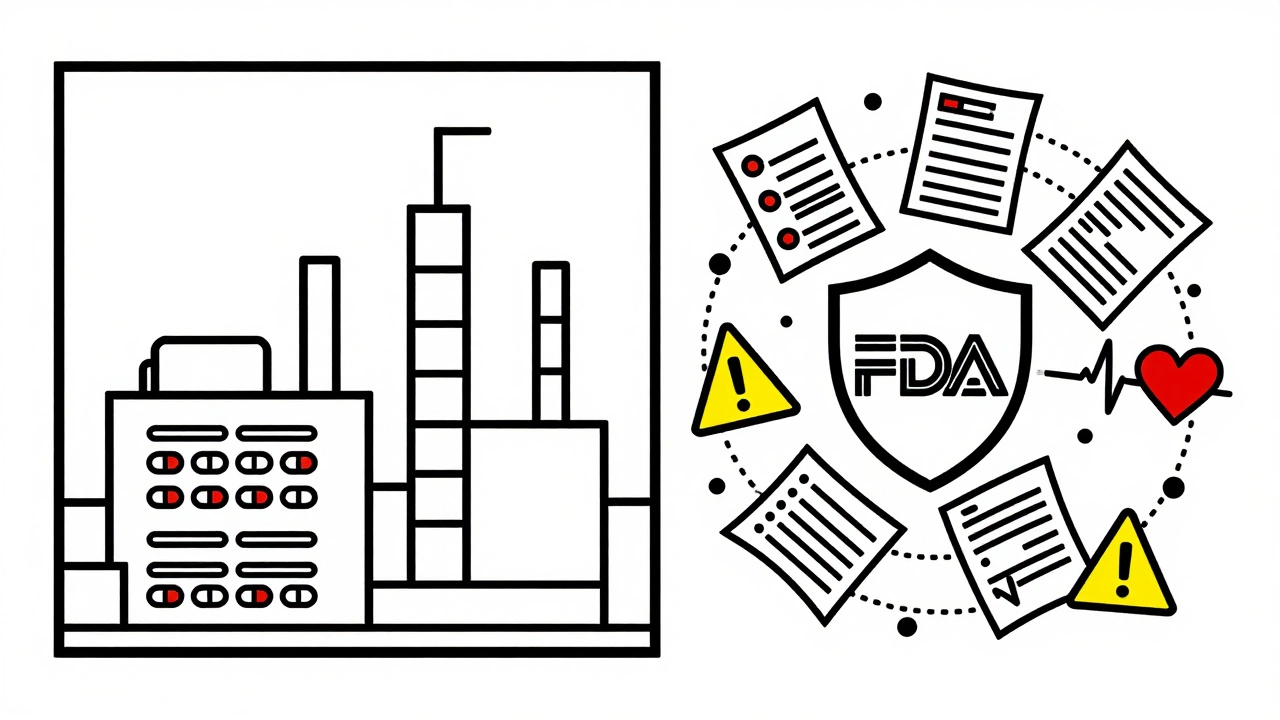
It’s not just about what the drug does in the body. It’s about how it’s made. The FDA sends inspectors to generic drug factories-sometimes unannounced-to check if they’re following strict quality rules. These inspections look at everything: how ingredients are mixed, whether equipment is clean, if the final product dissolves at the right rate. A tiny change in the filler material or coating can affect how the drug is absorbed. For simple generics, this might not matter. But for complex ones-like extended-release pills, inhalers, or topical creams-it can make a big difference.
That’s why the FDA pays special attention to complex generics. These aren’t just copies. They’re technically harder to match. An inhaler must deliver the same particle size and dose distribution as the brand. A topical cream must penetrate the skin the same way. Bioequivalence studies can’t always capture that. So the FDA watches these drugs even more closely after approval.
What Happens When Something Goes Wrong?
If the FDA finds a safety signal, they don’t wait. They act. Their Office of Generic Drugs works with the Office of Surveillance and Epidemiology to investigate. They might:
- Ask the manufacturer to change the drug’s label to warn about a new risk
- Issue a “Dear Healthcare Provider” letter explaining the concern
- Order a voluntary recall if the product is contaminated or mislabeled
- Require the company to run a new study
In some cases, the FDA has pulled generic versions off the market after finding manufacturing problems-like contamination with cancer-causing nitrosamines-or after confirming real safety issues that weren’t apparent during approval.
The Challenge: Differentiating Real Problems from Perceptions
One of the biggest hurdles in monitoring generics isn’t science-it’s perception. Many patients believe generics are inferior. That belief can change how they feel. A 2014 NIH study found that patients who were told they were switching from a brand-name drug to a generic often reported more side effects-even when the generic was chemically identical. This isn’t just in their head. The brain’s expectation can trigger real physical symptoms. That makes it harder for the FDA to tell if a report is about the drug itself or the patient’s mindset.
And then there’s the issue of multiple manufacturers. One generic version of a drug might come from five different companies. If patients report problems, which one is to blame? The FDA tracks lot numbers and manufacturer codes, but it’s not always clear. That’s why they’re pushing for better tracking systems and clearer labeling.
The Future: AI and Real-World Data
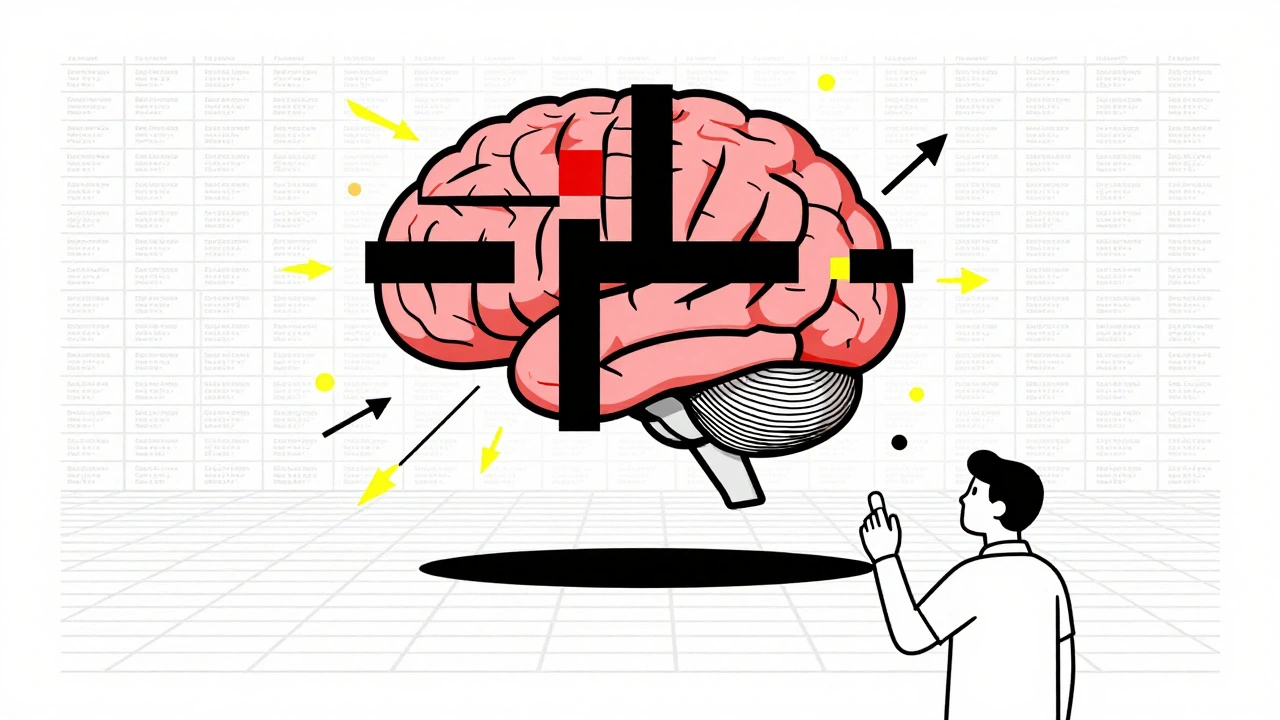
The FDA knows its current tools aren’t perfect. That’s why it’s investing in new technology. In 2023, the agency allocated $5.2 million specifically for research into AI and machine learning for post-market surveillance. The goal? To make detection faster and smarter.
Imagine an AI system that scans millions of electronic health records and insurance claims in real time. It learns what’s normal and flags anomalies-like a cluster of heart rhythm issues in patients taking a specific generic version of a statin. Instead of waiting months for reports to pile up, the system could alert regulators in weeks. The FDA is working with universities like Maryland and Michigan on this through the Center for Research on Complex Generics. Early projections suggest AI could cut signal detection time by 60-70% by 2027.
They’re also pushing to integrate more electronic health records into Sentinel. Right now, most data comes from insurance claims. But EHRs have richer detail-lab results, doctor notes, dosage changes. Adding those could help the FDA understand not just *if* something happened, but *why*.
What You Can Do
You don’t have to wait for the FDA to find a problem. If you notice something unusual after switching to a generic-your symptoms returning, new side effects, or even just a feeling that it’s not working the same way-talk to your doctor. And report it. You can file a report through MedWatch online in minutes. Your report might be the one that helps the FDA catch a pattern before it affects more people.
It’s not about distrust. It’s about partnership. Generics are essential to affordable healthcare. But safety doesn’t end at approval. It’s a shared responsibility-between regulators, manufacturers, doctors, and patients.


Clare Fox
December 7, 2025 AT 01:33so like... we trust the FDA to check pills after they're already in our medicine cabinets? that's wild. i mean, what if the batch i got last month was made in a factory with a broken thermometer? how do i even know?
Arjun Deva
December 7, 2025 AT 14:04THEY’RE LYING. EVERY SINGLE GENERIC IS A LAB EXPERIMENT FOR BIG PHARMA. THEY USE CHEAP INGREDIENTS FROM CHINA, THEN BLAME THE PATIENT WHEN IT DOESN’T WORK. I SAW A VIDEO ON TIKTOK-A DOCTOR SAID THE PILLS HAVE ‘UNLISTED FILLERS’ THAT CAUSE ANXIETY. THE FDA IS IN ON IT.
Jackie Petersen
December 8, 2025 AT 10:42generic drugs are just a scam. why do you think the brand names cost more? because they work. i switched to a generic for my thyroid med and felt like a zombie for three weeks. my doctor said ‘it’s the same chemical’-yeah right. the same chemical, different magic.
Annie Gardiner
December 8, 2025 AT 22:35you know what’s ironic? we’re told generics are just as good, but we’re also told to avoid them because they’re ‘inferior.’ so which is it? are they the same, or are they secretly poisoning us? i think the truth is somewhere between ‘they’re fine’ and ‘they’re a corporate experiment.’
Rashmi Gupta
December 9, 2025 AT 20:32in india, generics are the only option. we don’t have a choice. but we know the difference. one brand gives me headaches, another makes me sleepy, another does nothing. it’s not placebo. it’s the filler. the coating. the damn manufacturing process. we’ve all had this experience.
Kumar Shubhranshu
December 11, 2025 AT 10:58the system works. FDA catches most issues. report if you notice something. simple.
Priya Ranjan
December 11, 2025 AT 11:04if you’re taking generics, you’re already accepting lower quality. why are you surprised when it doesn’t work? you wouldn’t buy a knockoff iPhone and complain when the camera sucks. same thing. stop pretending it’s all the same.
Gwyneth Agnes
December 12, 2025 AT 05:55report your side effects. it takes two minutes. stop being passive.
Ashish Vazirani
December 14, 2025 AT 00:02you think the FDA cares? they’re just waiting for the next scandal. meanwhile, people are dying because a batch of generic metformin had nitrosamines and no one noticed for a year. this isn’t oversight. it’s negligence dressed up as science.
Kay Jolie
December 15, 2025 AT 13:11the sentinel initiative is a paradigm-shifting infrastructure for pharmacovigilance-leveraging real-world evidence (RWE) derived from heterogeneous, high-dimensional EHR datasets to enable dynamic signal detection at scale. this represents a quantum leap from passive FAERS reporting toward predictive, AI-driven pharmacodynamic surveillance. the integration of granular clinical phenotyping into the surveillance architecture is not merely incremental-it’s foundational to the next generation of drug safety analytics.
Dan Cole
December 15, 2025 AT 20:05the entire premise of bioequivalence is flawed. it assumes that identical plasma concentrations = identical clinical outcomes. but what about excipients? what about dissolution kinetics in different gut environments? what about epigenetic responses triggered by trace contaminants? we’re not just testing chemistry-we’re testing human biology in a system designed for simplicity. the FDA is playing whack-a-mole with a billion pills and calling it science.