
You’ve been eating clean, hitting the gym, tracking every calorie-and yet the scale won’t budge. After weeks of steady progress, you hit a wall. This isn’t laziness. It’s not failure. It’s your body doing exactly what it’s evolved to do: protect you from starvation.
Why Your Weight Loss Stalls (It’s Not Your Fault)
When you lose weight, your body doesn’t just shrink-it rewires itself. This isn’t a glitch. It’s a survival mechanism called metabolic adaptation. As you drop pounds, your body reduces how many calories you burn, even more than it should based on your new, lighter frame. This is called adaptive thermogenesis.
Back in the 1940s, scientists ran the Minnesota Starvation Experiment. Volunteers lost up to 25% of their body weight on a semi-starvation diet. Their resting metabolic rate dropped by nearly 40%-far beyond what their new weight predicted. Fast forward to today, and we now know this isn’t rare. It’s universal. Every person who loses significant weight experiences it, even if they don’t realize it.
Here’s the hard truth: if you’re burning 2,000 calories a day at your starting weight, you might only burn 1,700 at your goal weight-even if you keep the same activity level. That 300-calorie gap? That’s metabolic adaptation. And it’s why you can eat 1,200 calories a day and still not lose weight. Your body has lowered its energy needs to match your new reality.
What’s Actually Changing Inside Your Body
Metabolic adaptation isn’t one thing-it’s a cascade of physiological shifts:
- Leptin drops: This hormone tells your brain you’re full. After weight loss, leptin levels can plummet by up to 70%. Result? You feel hungrier, even when you’ve eaten enough.
- Thyroid activity slows: Your thyroid gland reduces hormone production to lower your metabolic engine. Less T3, less heat, less burn.
- Cortisol rises: Stress hormone levels increase, promoting fat storage and muscle breakdown-exactly what you don’t want.
- Brown fat turns down: Brown adipose tissue (BAT) burns calories to make heat. When you lose weight, BAT becomes less active, especially in women, who naturally have more of it.
- Proton leak decreases: At the cellular level, your mitochondria become more efficient-meaning they waste less energy as heat. More efficiency equals fewer calories burned.
These changes don’t disappear after you stop losing weight. Studies show they persist for over a year-even after you’ve maintained your new weight. Your body isn’t just defending its old size; it’s trying to bring you back to it.
Why Calorie Counting Alone Fails
Most diet plans assume your energy needs stay constant. They don’t. That’s why people hit plateaus and blame themselves. They think, “If I ate less, I’d lose more.” So they cut calories again. And again. And again.
But here’s what happens: you get hungrier. You feel exhausted. Your workouts suffer. Your mood tanks. And still, the scale doesn’t move. This isn’t a lack of willpower-it’s biology.
Research from the University of Alabama at Birmingham found that for every extra 10 kcal/day your metabolism adapts, it adds about one day to your weight loss timeline. If your body drops 150 kcal/day in energy expenditure, you’re looking at a 15-day delay-just from your metabolism, not your diet.
And here’s the kicker: rapid weight loss makes it worse. Diets under 800 calories a day trigger far stronger metabolic adaptation than gradual loss. The faster you lose, the harder your body fights back.
How to Break Through: Science-Backed Strategies
There’s no magic pill. But there are proven, practical ways to outsmart metabolic adaptation.
1. Take Diet Breaks
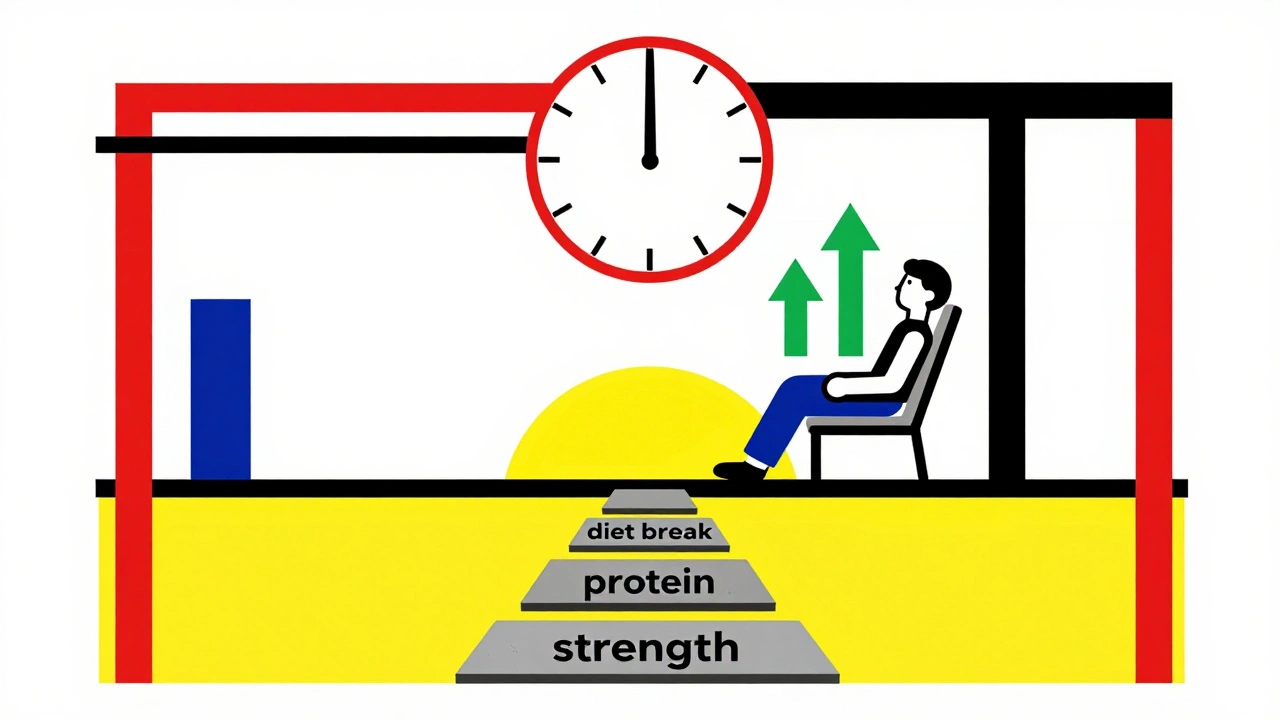
Instead of pushing through a plateau for months, take a 1- to 2-week break. Eat at your maintenance calories-no restriction, no guilt. This isn’t cheating. It’s recalibration.
Studies show diet breaks reduce metabolic adaptation by up to 50%. Your leptin rebounds. Your thyroid resets. Your energy returns. After the break, you’ll often find you can resume losing weight at a higher calorie intake than before.
Do this every 8 to 12 weeks of dieting. It’s not a pause-it’s part of the plan.
2. Lift Weights, Not Just Cardio
Cardio burns calories while you’re doing it. Strength training builds muscle-and muscle burns more calories at rest.
Research shows people who lift weights during weight loss lose 8-10% less resting metabolic rate than those who only do cardio. Muscle is metabolically active tissue. The more you have, the harder your body fights to hold onto it.
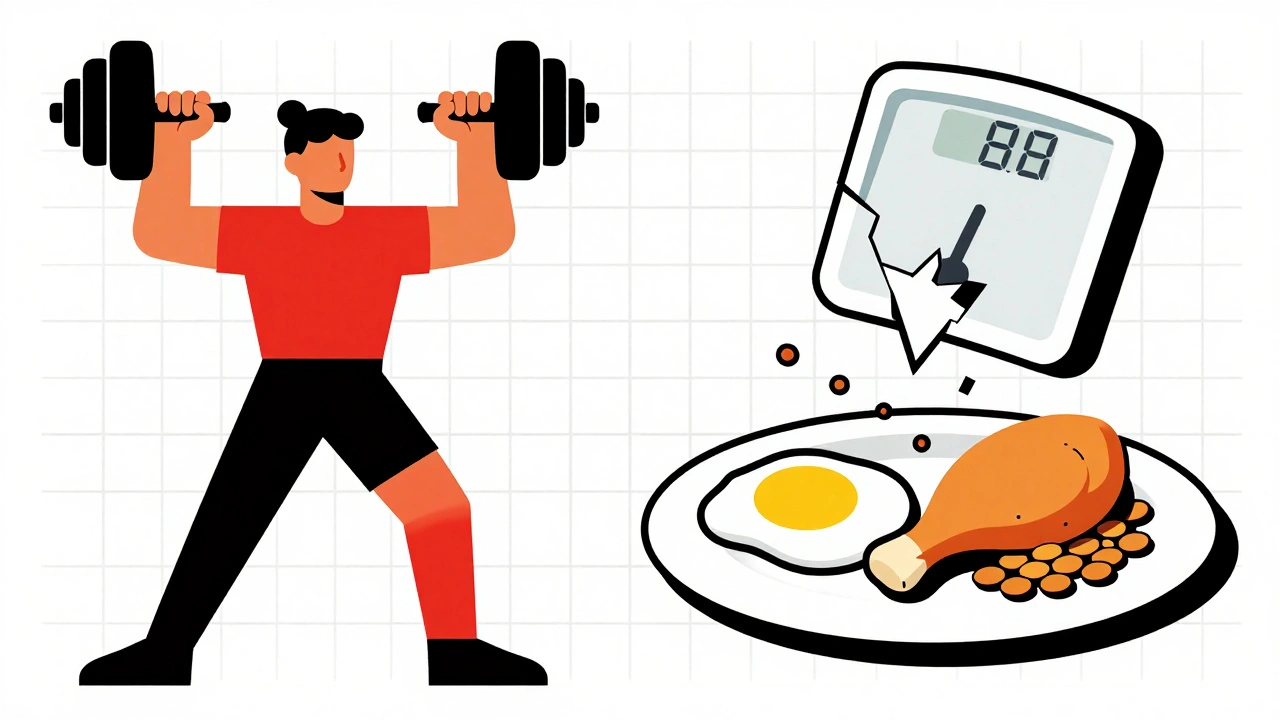
Three to four sessions a week of resistance training-squats, deadlifts, push-ups, rows-is enough. You don’t need to be a bodybuilder. Just move heavy things.
3. Eat More Protein
Protein isn’t just for building muscle-it’s your metabolic shield during weight loss.
Studies show that eating 1.6 to 2.2 grams of protein per kilogram of body weight preserves lean mass. That means more muscle, less fat loss, and a higher resting burn. In one trial, high-protein dieters lost 3.2 kg more fat and 1.3 kg less muscle than low-protein dieters.
That’s not a small difference. It’s the difference between losing 10 pounds of mostly fat-or 10 pounds of mostly muscle.
Good sources: eggs, chicken, fish, tofu, Greek yogurt, lentils, whey protein.
4. Try Reverse Dieting
If you’ve been stuck at 1,200 calories for months, don’t jump back to 2,000. Ease into it.
Reverse dieting means slowly adding 50-100 calories per week-mostly from carbs and protein-until you reach maintenance. This teaches your metabolism to handle more food without gaining fat. It rebuilds your metabolic flexibility.
It’s not about getting fat. It’s about getting your metabolism back.
What Doesn’t Work (And Why)
Not all advice is created equal. Here’s what to avoid:
- Extreme calorie cuts: They trigger stronger adaptation and increase muscle loss.
- Detox teas and fat-burning supplements: They don’t reverse metabolic adaptation. They’re just expensive water.
- Skipping meals: This spikes cortisol and lowers metabolism further.
- Only focusing on the scale: Weight isn’t the only measure. Take measurements, photos, and note energy levels. Muscle gain can mask fat loss.
One Reddit user, FitJourney2023, cut calories to 1,200 after losing 30 pounds-and hit a 12-week plateau. She was hungrier than ever. She didn’t know her body had adapted. When she took a 10-day break at maintenance and added strength training, she lost 4 more pounds in the next 3 weeks.
Pharmaceuticals and Surgery: When to Consider Them
For some, lifestyle changes aren’t enough. That’s not weakness-it’s biology.
GLP-1 agonists like semaglutide (Wegovy) help by reducing hunger and increasing fullness, countering the leptin drop. In trials, users lost nearly 15% of their body weight. These aren’t shortcuts-they’re tools that help your body accept a new, lower weight.
Bariatric surgery works differently. It doesn’t just restrict food-it changes gut hormones, resets metabolism, and reduces adaptation by about 60% compared to dieting alone. But it’s invasive. It’s not for everyone.
And while companies are investing billions in drugs that activate brown fat or boost UCP-1, those aren’t available yet. For now, the best tools are still diet, movement, and patience.
The Future of Weight Loss
By 2025, most science-backed weight loss programs will include metabolic adaptation strategies. WW now personalizes calorie targets. Noom includes “metabolic reset” modules. The focus is shifting from “eat less, move more” to “work with your body, not against it.”
Researchers are even exploring cold exposure to activate brown fat. One study showed 5-7% more calories burned after weeks of mild cold exposure. It’s early, but it shows how much we’re learning.
As Dr. David Ludwig from Harvard says, the next frontier isn’t about willpower. It’s about understanding your biology.
What to Do Right Now
If you’re stuck:
- Stop cutting calories. Eat at maintenance for 10-14 days.
- Add 2-3 strength training sessions per week.
- Hit at least 1.6g of protein per kg of body weight daily.
- Track energy, hunger, and mood-not just the scale.
- Be patient. Your metabolism isn’t broken. It’s just protecting you.
Plateaus aren’t the end of your journey. They’re a signal. Listen to them. Adjust. Keep going.
Why am I not losing weight even though I’m eating less?
Your body has adapted to your lower weight by reducing how many calories it burns. This is called metabolic adaptation. Cutting calories further often makes it worse by increasing hunger and muscle loss. Instead, try a short break at maintenance calories, add strength training, and increase protein intake.
How long does a weight loss plateau last?
Most plateaus last 4-8 weeks if you keep doing the same thing. But with the right adjustments-like a diet break or increased protein-you can break through in 1-3 weeks. The key is changing your strategy, not just pushing harder.
Do diet breaks cause weight gain?
A short 1-2 week break at maintenance calories typically leads to minimal or no fat gain. Any weight gain is usually water or glycogen, which drops quickly when you resume eating at a deficit. The benefit-resetting your metabolism and hormones-far outweighs the temporary scale fluctuation.
Is metabolic adaptation the same for men and women?
Women tend to experience stronger metabolic adaptation due to higher levels of brown fat and hormonal shifts during energy restriction. Leptin drops more sharply in women, and their resting metabolic rate declines more than men’s at the same weight loss level. This doesn’t mean it’s harder for women-it just means they may need slightly longer diet breaks and more protein.
Will my metabolism ever go back to normal?
Your metabolism won’t fully return to what it was before you lost weight, but it can stabilize at a healthy, sustainable level. With consistent maintenance, strength training, and adequate protein, your body learns to function well at your new weight. It’s not about going back-it’s about building a new normal.



Lara Tobin
December 14, 2025 AT 00:52I’ve been stuck for 6 months and this post literally made me cry. Not because I’m upset-because someone finally gets it. I thought I was broken, but turns out my body was just trying to keep me alive. Thank you.
Just started my 10-day maintenance break today. No guilt. No tracking. Just eating like I used to before the obsession. Feels weird. Feels right.
Also, I’m crying again. This time because I’m not alone.
❤️
Keasha Trawick
December 15, 2025 AT 03:47Okay, let’s geek out for a sec-this isn’t just metabolic adaptation, it’s a full-blown endocrine recalibration event. Leptin crash? Check. T3 suppression? Obvious. Brown fat downregulation? Especially pronounced in females due to estrogen-mediated BAT density. And proton leak? That’s mitochondrial efficiency at the cost of thermogenesis-basically your cells went from gas-guzzling Hummers to Priuses. No wonder you’re stuck.
Reverse dieting isn’t ‘cheating’-it’s metabolic re-education. You’re teaching your mitochondria to stop hoarding ATP like it’s the apocalypse. And protein? 2.2g/kg isn’t ‘a lot,’ it’s the bare minimum to preserve lean mass while your hypothalamus throws a tantrum. If you’re not hitting that, you’re just losing muscle and calling it ‘fat loss.’
Also, cold exposure? I’m doing 10 mins of ice baths 3x/week. Not for the ‘detox’ nonsense-because UCP-1 activation is real. Burned 120 extra calories yesterday just sitting there shivering. Science is wild.
Alvin Montanez
December 17, 2025 AT 00:27Look, I’ve seen this exact post 47 times on Reddit. Everyone thinks they’re special because they hit a plateau. Newsflash: your body isn’t conspiring against you-it’s just doing what every mammal has done for 2 million years. You didn’t ‘outsmart evolution’ by eating kale and doing yoga. You just triggered the same ancient survival protocol as a starving Inuit in winter.
Stop romanticizing this. It’s not a ‘journey.’ It’s biology. And if you’re still trying to lose weight after 18 months of dieting, maybe the real problem is that you’re still dieting. You’re not a scientist. You’re not a metabolic engineer. You’re a human who got hooked on the idea that your worth is measured in pounds.
And if you think GLP-1 agonists are ‘tools,’ you’re one step away from becoming a pharmaceutical poster child. Wake up. Your body doesn’t need a drug to tell it you’re not starving. It needs you to stop pretending you can out-logic evolution.
kevin moranga
December 17, 2025 AT 11:37Hey, I’ve been there. 2021, I lost 50 lbs on 1,400 calories. Then-bam-plateau for 8 months. I thought I was lazy. Turns out, I was just exhausted. My body was begging me to stop.
I did the 14-day maintenance break. Ate pizza. Ate ice cream. Ate carbs like they were going out of style. Gained 3 lbs-mostly water. Felt like a failure.
Then I started lifting. Not fancy. Just squats, push-ups, rows. Three times a week. And I ate 1.8g protein per kg. No magic. Just consistency.
Three weeks later, I lost 5 lbs. Not because I cut calories. Because I gave my body permission to heal.
You’re not broken. You’re just tired. Rest. Lift. Eat. Repeat. You’ve got this.
Emma Sbarge
December 19, 2025 AT 06:47As an American who’s watched this country turn weight loss into a moral crusade, I’m tired. We’re told to ‘just eat less and move more’ like it’s a virtue. But when your body adapts, we call it ‘lack of discipline.’ That’s not just wrong-it’s dangerous.
This post nails it. It’s not about willpower. It’s about physiology. And if you’re still blaming yourself for a plateau, you’ve been sold a lie.
Stop listening to influencers. Start listening to your body. And if you need a diet break? Take it. No shame. No guilt. Just science.
Donna Hammond
December 20, 2025 AT 16:42For anyone reading this and feeling defeated: you are not failing. Your body is not broken. You are not lazy. You are not weak.
Metabolic adaptation is not a flaw-it’s a feature. Your body is protecting you from starvation. That’s not weakness. That’s wisdom.
Here’s what you need to do next: stop counting calories for 10 days. Eat enough. Eat protein. Sleep 7+ hours. Move your body with weights, not just cardio. And then-wait. Not because you’re hoping for magic, but because you’re giving your biology a chance to reset.
This isn’t a quick fix. It’s a long-term partnership with your own physiology. And when you stop fighting it, you’ll finally start winning.
You’ve already done the hardest part-you showed up. Now let your body do the rest.
Richard Ayres
December 21, 2025 AT 15:22I appreciate the depth of this post. The science is clear, the strategies are grounded, and the tone avoids the usual guilt-tripping that plagues this space.
One thing I’d add: sleep and stress management are non-negotiable. Cortisol doesn’t just rise-it lingers. And chronic stress turns every calorie into a potential fat-storage signal. If you’re doing everything right but still stuck, look at your sleep quality and your mental load.
Also, don’t underestimate the power of community. We’re social creatures. Isolation makes metabolic adaptation worse. Talk to someone. Share your struggle. You’re not alone in this.
Scott Butler
December 22, 2025 AT 08:14Ugh. Another one of these ‘your body is a magic box’ posts. Look, I’ve been in the military. We didn’t have time for ‘metabolic adaptation.’ We ate what we were given, trained hard, and lost weight. No breaks. No protein obsession. No cold showers.
Back in my day, men didn’t whine about plateaus. They just kept going. You want results? Stop overthinking. Eat less. Move more. Period.
And if you’re using GLP-1 drugs like they’re vitamins, you’re not tough-you’re weak. Real men don’t need pharmaceuticals to lose weight.
Stop listening to these ‘experts.’ Just do the work.