

Imagine you’re prescribed a cream for eczema. It works. Your skin clears up. Then your pharmacy hands you a cheaper version - same name, same active ingredient, same price. But it doesn’t work the same. You’re back to scratching. This isn’t rare. It happens because proving that a complex generic drug works just like the brand-name version isn’t like copying a recipe. It’s more like reverse-engineering a locked engine while blindfolded.
What Makes a Generic Drug "Complex"?
Not all generics are the same. Most are simple pills - small molecules that dissolve in your stomach, get absorbed into your blood, and travel to where they’re needed. These are easy to test. You measure how much drug shows up in your bloodstream over time. If the generic matches the brand within 80-125%, it’s approved. But complex generics? They don’t work that way. They’re designed to act locally - on your skin, in your lungs, in your eyes. Think inhalers for asthma, creams for psoriasis, eye drops for glaucoma, or injectables that release medicine slowly over weeks. These aren’t meant to flood your blood. They’re meant to stay put and work right where they’re applied. The FDA defines complex generics as products with unusual ingredients, delivery systems, or formulations. That includes:- Liposomes (tiny fat bubbles that carry drugs)
- Nanoparticles and colloids
- Extended-release injectables
- Transdermal patches
- Metered-dose inhalers
- Topical gels and emulsions
- Drug-device combos like auto-injectors or nasal sprayers
The Bioequivalence Problem: You Can’t Measure What You Can’t See
Bioequivalence means two drugs deliver the same amount of medicine, at the same speed, to the same place. For pills, that’s easy - you draw blood. For an inhaler? You can’t stick a tube into someone’s lung to measure how much budesonide landed in their airways. That’s the core problem. Traditional bioequivalence studies rely on blood levels. But for topical or inhaled drugs, blood levels don’t tell you anything. The drug might never enter the bloodstream at all. It’s working right where it’s applied. So what do you do? You try to measure it another way. For inhalers, you check particle size. Too big? It hits your throat. Too small? It goes too deep. The sweet spot? 1-5 micrometers. But no single test is accepted worldwide. The FDA wants one method. The EMA wants another. Manufacturers have to run both. For creams? You need to prove the drug penetrates the same layers of skin. But skin varies - thickness, moisture, oil content - between people. And the cream’s texture? A tiny change in the emulsifier can make it spread differently, change how fast it dries, or alter how much drug gets absorbed. That’s enough to break bioequivalence.The Reverse-Engineering Nightmare
Generic makers don’t get the brand’s recipe. They don’t know the exact ratio of ingredients. They don’t know the mixing temperature. They don’t know how long the product was stirred. All they have is the final product on the shelf. So they reverse-engineer it. They break it down. Analyze it. Test it. Try to rebuild it. It’s like trying to recreate a famous chef’s sauce by tasting it and guessing what’s in it. You might get close. But if you miss one ingredient - say, a stabilizer that prevents the nanoparticles from clumping - the whole thing fails. This process, called de-formulation, takes years. And even then, you’re guessing. The brand might have used a proprietary manufacturing process that can’t be duplicated without the original equipment or know-how. A change in the order of mixing? A different drying temperature? It can wreck the product’s performance. One study found that complex generics take 2.5 to 3 times longer to develop than simple ones. And more than 70% fail at the bioequivalence stage.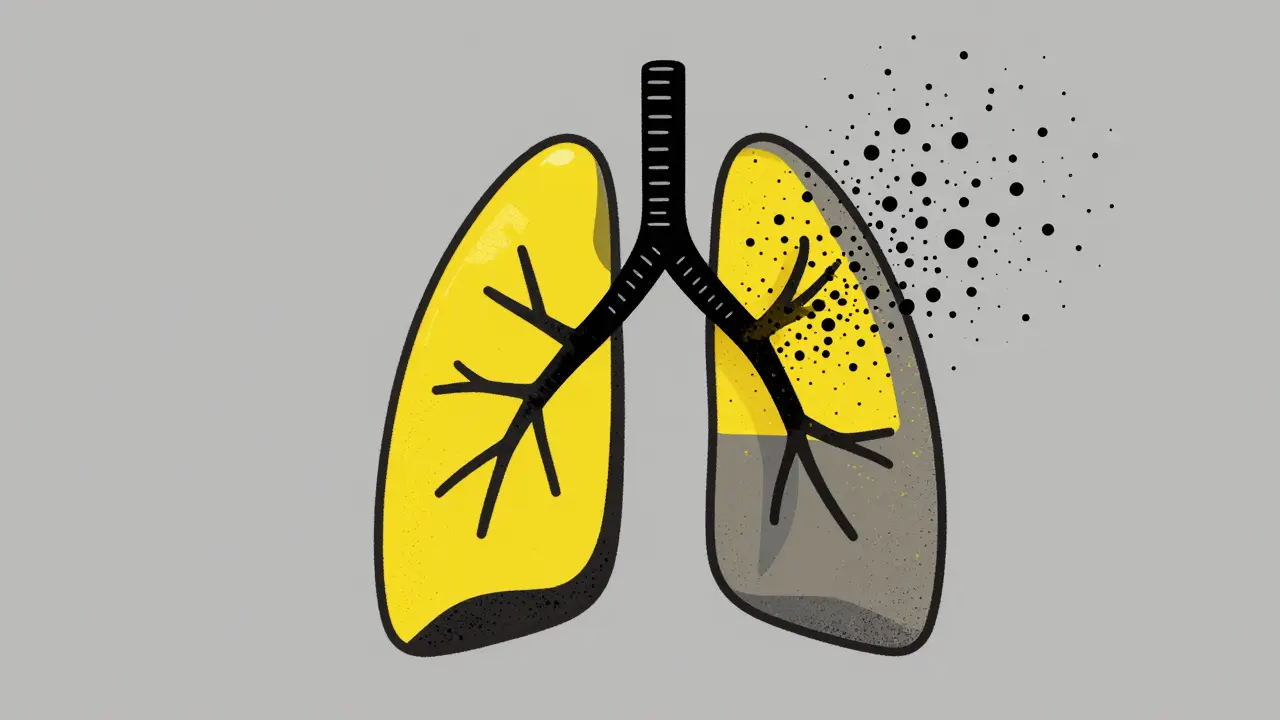
Stability Is a Silent Killer
Complex formulations are fragile. Heat. Humidity. Light. Even the packaging can change how the drug behaves over time. A liposomal cream might look fine after six months. But under the microscope, the fat bubbles have merged. The drug inside is leaking out. Or the particles have grown too large. The cream still looks the same. But it doesn’t work the same. Stability testing for these products is a nightmare. You have to test for dozens of variables - particle size, viscosity, pH, drug content, microbial growth - over months or years. And you have to do it across different climates. A product stable in Sydney might degrade in Mumbai. One manufacturer told researchers they spent $12 million and 18 months trying to stabilize a topical gel. They failed. The brand version lasted three years. Their version degraded in 14 months.Regulatory Confusion and the Cost of Delay
Different countries want different proof. The FDA might accept an in vitro test showing how a cream releases drug from the base. The EMA might demand a clinical trial measuring skin improvement in patients. The same product. Two different paths. Two different costs. Manufacturers say 89% of their biggest challenge is bioequivalence testing methods. 76% say stability is a nightmare. 68% say they can’t even agree on how to measure the product’s physical properties. And it’s expensive. Developing a complex generic can cost 10 times more than a simple pill. And if you fail? You start over. Many companies just walk away.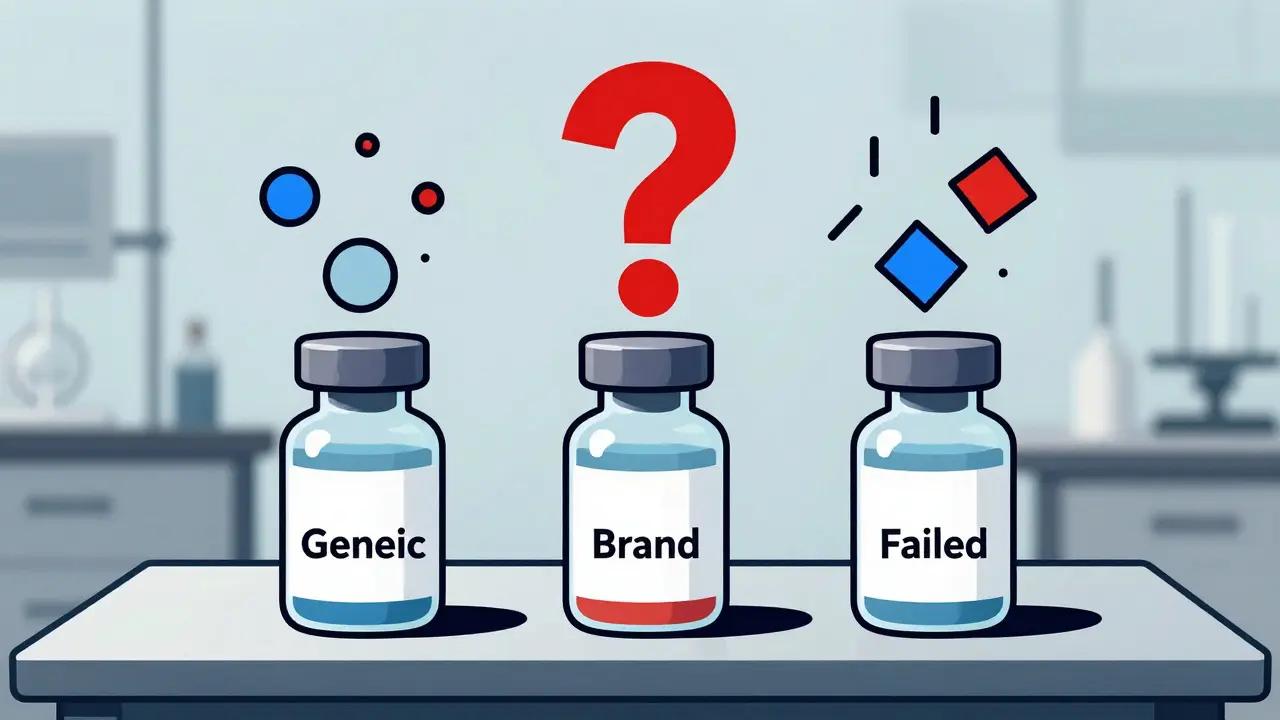
What’s Changing? New Tools, New Hope
The FDA knows this is a problem. They’ve created the Complex Generic Drug Products Committee. They’ve published 15 new guidance documents since 2022 - for inhalers, topical steroids, testosterone gels, and more. They’re investing in new science:- Physiologically-based pharmacokinetic (PBPK) modeling - computer simulations that predict how a drug behaves in the body based on its chemistry and physical properties. This could cut bioequivalence studies by up to 60% for some products.
- In vitro lung deposition models - machines that mimic how inhalers work in the lungs, measuring where particles land without using people.
- Advanced imaging - lasers and cameras that track how creams penetrate skin layers in real time.
- Standardized analytical methods - new lab protocols for testing liposomes, nanoparticles, and suspensions that everyone agrees on.
The Bigger Picture: Why This Matters
Complex drugs aren’t cheap. A single inhaler for COPD can cost $500 a month. A topical treatment for psoriasis? $1,200. These aren’t luxuries. They’re necessities. If generics can’t get approved, patients pay more. Insurance companies push back. Hospitals ration. People skip doses. The market for complex generics is worth $120 billion in the U.S. alone. Sales are projected to grow from $15 billion in 2023 to $45 billion by 2028. That’s a 24.6% annual increase. But progress is slow. The science is hard. The regulators are cautious. The costs are high. Still, the pressure is building. Patients need cheaper options. Payers need savings. Innovation is happening - just not fast enough.What’s Next?
The future of complex generics depends on three things:- Harmonization - if the FDA, EMA, and others agree on one set of standards, development time drops. The ICH is working on this now.
- Technology access - if smaller labs can afford the tools to test nanoparticles or simulate lung deposition, more companies can enter the market.
- Regulatory flexibility - accepting in vitro data, modeling, and advanced characterization instead of always demanding human trials.
Why can’t we just use blood tests for complex generics like inhalers or creams?
Blood tests only show how much drug enters the bloodstream. But complex generics like inhalers or topical creams are designed to act locally - in the lungs, on the skin, or in the eyes. The drug often never reaches the blood at all, or only in tiny amounts. So measuring blood levels tells you nothing about whether the drug is working where it’s supposed to. That’s why regulators need new methods - like particle size analysis for inhalers or skin penetration imaging for creams.
What’s the difference between a simple generic and a complex generic?
Simple generics are pills with small-molecule drugs that dissolve in the stomach and enter the bloodstream. Their bioequivalence is proven by comparing blood levels of the active ingredient. Complex generics involve advanced delivery systems - like liposomes, nanoparticles, inhalers, or patches - where the drug doesn’t rely on blood absorption. Their performance depends on physical properties like particle size, viscosity, or release rate, which are harder to measure and control.
Why do complex generics take so long and cost so much to develop?
Developing a complex generic requires reverse-engineering a product without knowing its formula or manufacturing process. You must replicate exact particle sizes, emulsion structures, or release profiles - often with no standardized tests to prove you’ve succeeded. Stability testing takes years. Regulatory agencies demand different data. Failure rates exceed 70%. One complex generic can cost $10-20 million and take 5-7 years - compared to $2-5 million and 2-3 years for a simple pill.
Are complex generics as safe and effective as brand-name drugs?
Yes - when they’re approved. The FDA requires complex generics to meet the same safety and effectiveness standards as brand-name drugs. But the problem is getting approval. Many complex generics fail because current testing methods aren’t good enough to prove equivalence. Once approved, however, they perform just like the original. The issue isn’t quality - it’s proof.
What’s being done to make complex generics easier to develop?
The FDA is investing in new tools: computer modeling (PBPK), in vitro lung and skin tests, and standardized lab methods for nanoparticles and liposomes. They’re also encouraging early meetings with manufacturers to align on testing plans. The International Council for Harmonisation (ICH) is working on global standards to reduce duplication. These efforts could cut development time by 25-30% in the next five years.
For patients, the wait for affordable complex generics is long. For manufacturers, the path is full of scientific traps. But the stakes are high - and the science is finally catching up.


Lauren Warner
January 11, 2026 AT 00:09The FDA's current bioequivalence standards for complex generics are a joke. We're asking labs to replicate nanoscale emulsions with off-the-shelf equipment while ignoring manufacturing nuances that take years to perfect. The system isn't broken-it was designed to fail these products from the start.
Craig Wright
January 11, 2026 AT 02:44It's absurd that European regulators demand clinical trials for topical creams while the FDA accepts in vitro data. This isn't science-it's bureaucratic nationalism. If we want affordable medicine, we need one global standard, not 17 competing ones.
Lelia Battle
January 12, 2026 AT 04:27There's a deeper philosophical question here: if we can't measure a drug's effect directly, how do we know it's working? We're relying on proxies-particle size, viscosity, release rate-but these are just shadows of the real mechanism. The science is catching up, but our epistemology hasn't kept pace.
steve ker
January 13, 2026 AT 19:09so basically rich pharma companies make it hard for generics so they can keep charging 1000 bucks for a tube of cream
George Bridges
January 14, 2026 AT 21:31I've seen patients cry because their insurance denied the brand-name inhaler and the generic didn't work. This isn't just about science-it's about dignity. People deserve to breathe without bankruptcy.
Faith Wright
January 15, 2026 AT 12:20Oh so now we're pretending that reverse-engineering a liposomal cream is like baking a cake? Tell that to the 70% of generics that fail. At least with pills you can just measure the blood. With this? You're basically guessing while holding a microscope and praying.
Prachi Chauhan
January 15, 2026 AT 22:45think about it-our skin is not a blank slate. It changes with weather, stress, diet. How can a cream be "bioequivalent" if the surface it's applied to isn't? We're measuring the wrong thing.
Katherine Carlock
January 16, 2026 AT 10:35I work in a clinic and I've seen this firsthand. A patient switched from the brand to the generic steroid cream and got worse. We had to go back. The generic looked identical. But the texture? Slightly thicker. That changed everything. The science isn't there yet, and patients are paying the price.
Sona Chandra
January 16, 2026 AT 12:07THIS IS WHY MEDICINE IS A SCAM. THEY MAKE YOU PAY 1000 DOLLARS FOR A TUBE OF CREAM THEN THEY MAKE A CHEAPER VERSION THAT DOESN'T WORK SO YOU HAVE TO PAY AGAIN. IT'S A RACKET. THE PHARMA BOSS IS LAUGHING RIGHT NOW.
beth cordell
January 17, 2026 AT 00:57Just read this and cried a little 😔. My mom’s psoriasis cream cost $1200/month. The generic failed. She stopped using it. Now she’s in pain. We need better science, not more bureaucracy.
Rinky Tandon
January 17, 2026 AT 03:15Everyone keeps talking about PBPK modeling like it’s magic. But if you can’t even standardize how to measure nanoparticle size across labs, how are you going to trust a computer model? This is like building a rocket with a ruler and a prayer.
Ben Kono
January 17, 2026 AT 12:32why do we even need complex generics anyway just give people the brand name and move on
Cassie Widders
January 18, 2026 AT 16:36My dad used an asthma inhaler for 20 years. The generic failed. He didn't know why. He just stopped using it. Now he's on oxygen. This isn't abstract. It's people.