
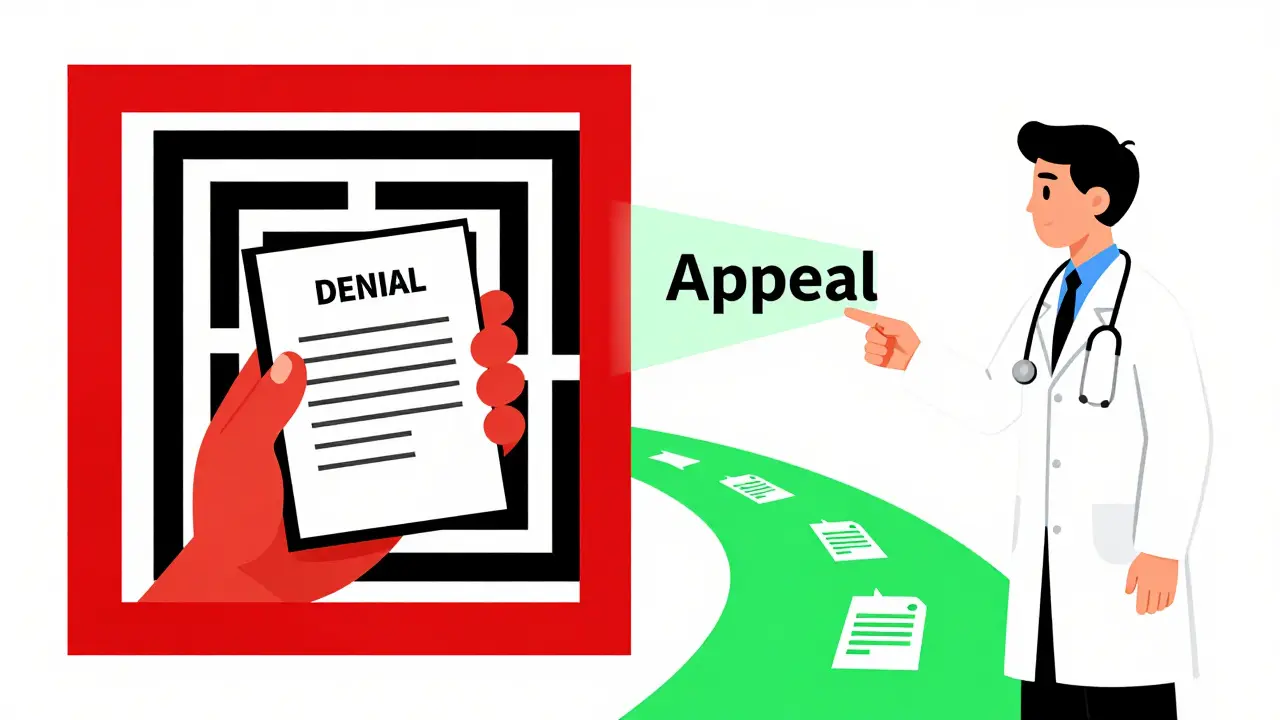
When your doctor prescribes a medication and your insurance says no, it’s not just frustrating-it can be dangerous. You might be sitting with a prescription in hand, ready to fill it, only to get a letter saying your drug needs prior authorization and they’re denying it. You’re not alone. About 6% of all prior authorization requests get denied in the U.S., and most people never fight back. But here’s the thing: 82% of those denials get reversed when you appeal. That’s not luck. That’s a system that’s broken at the start, not at the end.
Understand Why Your Medication Was Denied
The first thing you need to do is read the denial letter. Not skim it. Read it like you’re solving a puzzle. Insurance companies don’t deny medications randomly. They give you a reason, even if it’s buried in fine print. There are three main reasons they say no:- Incomplete paperwork (37% of denials): Missing forms, wrong dates, or unclear signatures.
- Lack of medical necessity (48%): They don’t believe your condition justifies this drug over a cheaper alternative.
- Not covered by your plan (15%): The drug isn’t on their list, even if your doctor says it’s the only option.
Some letters say things like “alternative therapy preferred” or “step therapy required.” That means they want you to try cheaper drugs first-even if those drugs didn’t work for you before. That’s where your appeal starts.
Gather Every Piece of Evidence
You can’t appeal with just your word. You need proof. Your doctor’s notes aren’t enough-you need the full story. Here’s what you need to collect:- Full medical records from your doctor’s office, especially notes about your diagnosis and treatment history.
- Lab results, imaging reports, or any test showing your condition isn’t improving with other drugs.
- A letter from your doctor written specifically for the appeal. It should include your diagnosis, why this drug is necessary, and why alternatives failed.
- A list of all medications you’ve tried before, with dates, dosages, and what happened when you took them. For example: “March 2023: Took Metformin 500mg twice daily for 8 weeks. Blood sugar remained above 180. Side effects: nausea, fatigue.”
- Your insurance ID number, full name, date of birth, and the exact name of the drug (including brand and generic if applicable).
One patient on Reddit reversed a Humira denial in just 7 days by including a two-page timeline of every failed treatment, with exact dates and symptoms. That’s the level of detail insurers respond to.
Follow Your Insurer’s Exact Process
Every insurance company has its own rules. You can’t just email them or call and hope it sticks. You have to follow their procedure-exactly.Check your denial letter. It should say how to appeal. If it doesn’t, call their member services and ask for the “prior authorization appeal form” or “grievance procedure.” Don’t take “I don’t know” for an answer. Ask for a supervisor. Most insurers require you to submit your appeal in writing, either by mail, fax, or through an online portal.
Here’s what major insurers require:
- CVS/Caremark: Must include your full name, ID, date of birth, drug name, and a clear statement of intent to appeal. Fax to 1-888-836-0730.
- UnitedHealthcare: Must be submitted through their online provider portal. Paper submissions are often rejected.
- Kaiser Permanente: Appeals go through their member services portal, and you must include CPT and ICD-10 codes.
And don’t forget the deadline. Most insurers give you 180 days from the date of denial to file. That’s six months. Don’t wait. Start right away.
Write a Clear, Specific Appeal Letter
Your appeal letter isn’t a complaint. It’s a clinical argument. It needs to match the insurer’s own coverage rules. Here’s how to structure it:- State your intent clearly: “I am formally appealing the denial of [drug name] for [patient name].”
- Address the denial reason head-on: If they said “medical necessity not met,” explain why. Use their language. For example: “Per your plan’s clinical policy on [drug class], medical necessity is established when step therapy has failed. Patient tried [Drug A] for 12 weeks with no improvement.”
- Include specific codes: CPT codes for procedures, ICD-10 codes for diagnosis. 89% of approved appeals include these.
- Attach supporting documents: “See attached: Medical records dated [date], lab results from [clinic], and physician letter.”
- End with a request: “Please approve coverage immediately to avoid interruption in treatment.”
Dr. Sonali Patel from Keck Medicine says appeals with this structure have an 85%+ success rate. Why? Because they don’t ask-they prove.
Get Your Doctor Involved
Your doctor’s voice matters more than yours. Insurers listen to doctors. But many doctors don’t know how to write an effective appeal letter.Ask your doctor to:
- Write a letter on official letterhead.
- State clearly: “This medication is medically necessary due to [reason].”
- Reference the insurer’s own coverage guidelines.
- Include the patient’s history of failed alternatives.
Studies show appeals with direct physician input are 32% more likely to succeed. If your doctor refuses to help, ask for a referral to a specialist who will. Sometimes, a rheumatologist or endocrinologist writing the letter carries more weight than your primary care provider.
Track Everything
Once you submit your appeal, don’t assume it’s done. Track every step:- Save a copy of everything you send.
- Write down the date you mailed or uploaded it.
- Get a reference number if they give you one.
- Call after 10 business days if you haven’t heard back. Ask for the case number and who’s reviewing it.
Seventy-eight percent of physicians say they have to call multiple times to get a response. That’s normal. Don’t give up. Keep a log: “Called 2/1/2026, spoke to Lisa, case still pending.”
Some insurers take 30 days. Others take 60. If you’re on a self-insured plan (common with big employers), federal law says they must respond within 60 days. If they don’t, you can escalate.
Know Your Next Steps If You’re Still Denied
If your appeal gets denied, you’re not out of options. You can request an external review. This means an independent third party-not your insurer-looks at your case.You have 365 days from your final denial to request this, according to Healthcare.gov. But state rules vary. Some states give you only 60 days. Check your state’s insurance department website.
External reviews are powerful. They’re legally binding. If the reviewer says yes, your insurer must cover the drug. But this process can take 30 to 90 days. Don’t wait until the last minute.
There’s also the No Surprises Act, which allows independent dispute resolution for certain high-cost drugs-but it’s rarely used. Only 0.3% of denials go this route. It’s complicated, so stick to the external review unless your drug costs over $1,000 per month.

What to Do If You Can’t Wait
Waiting weeks for an appeal can be dangerous if you’re on a life-saving drug. If you’re running out, ask your doctor for a 30-day emergency override. Many insurers allow this if you can prove immediate health risk.Also, ask your pharmacy if they offer patient assistance programs. Drug manufacturers often give free medication to people who qualify based on income. Companies like AbbVie (Humira), Pfizer, and Roche have these programs. Your pharmacist can help you apply.
Some nonprofit groups like the Patient Access Network Foundation (PAN) or the HealthWell Foundation also help cover copays for specialty drugs.
Why This Is So Hard-and Why It’s Worth It
Prior authorization was meant to stop unnecessary spending. But today, it’s a bureaucratic nightmare. Ninety-three percent of doctors say it causes delays in care. Nearly 80% of patients abandon treatment because of these denials.But here’s the truth: the system works if you push back. The reversal rate is 82% because the initial denials are often mistakes. Administrative errors account for 41% of all denials. You’re not fighting your insurer-you’re fixing their error.
It takes time. It takes effort. It takes six to eight hours of your life to get one drug approved. But that’s less than the cost of a hospital visit you could avoid by staying on your medication.
And you’re not alone. Millions of people go through this every year. You’re not asking for special treatment. You’re asking for the treatment your doctor prescribed. That’s your right.
What should I do if my insurance denies my medication without giving a reason?
If your denial letter is vague or missing details, call your insurer’s member services immediately. Ask for a written explanation under the Affordable Care Act, which requires them to provide a clear reason. If they refuse, file a formal complaint with your state’s insurance department. You can also ask your doctor to write a letter stating the denial is unclear and request a review based on medical necessity.
Can I appeal if I’m on Medicare Advantage?
Yes. Medicare Advantage plans must follow the same appeal rules as private insurers, but they have faster timelines. As of 2024, CMS requires them to respond to prior authorization requests within 72 hours. If they deny, you have 60 days to appeal internally, then 60 more days to request an external review. Medicare Advantage plans have a 22% higher appeal success rate than commercial plans, so your chances are better than you think.
How long does a prior authorization appeal take?
Internal appeals usually take 30 days, but can extend to 60 if more information is needed. External reviews take longer-between 30 and 90 days. If your case is urgent (like a life-threatening condition), you can request an expedited review. Insurers must respond within 72 hours in urgent cases. Always mark your appeal as “urgent” if your health is at risk.
What if my doctor won’t help me appeal?
If your doctor refuses, ask for a referral to a specialist who treats your condition. Specialists often have more experience with prior authorization appeals. You can also contact patient advocacy groups like the National Patient Advocate Foundation or the Chronic Disease Fund. They can help you draft letters and connect you with legal resources if needed.
Are there free tools to help me appeal?
Yes. The Patient Advocate Foundation offers free appeal templates and step-by-step guides. The Obesity Action Coalition has a downloadable appeal letter builder for specialty drugs. Many state insurance departments also offer free patient assistance programs. Check your state’s website or call their consumer hotline. You don’t need to pay for help.
What to Do Next
Start today. Don’t wait until your prescription runs out. Get your denial letter. Call your doctor’s office and ask for your medical records. Print out the insurer’s appeal instructions. Write your letter. Attach your evidence. Send it. Then call in a week. Keep going. Every appeal you file makes it harder for insurers to ignore real medical need.Medication isn’t a luxury. It’s your health. And you have the right to fight for it.



Iona Jane
January 16, 2026 AT 12:13This system is rigged and you know it
Sohan Jindal
January 16, 2026 AT 18:17They don't deny meds because of paperwork. They deny them because Big Pharma pays them to. You think this is about cost? Nah. It's about control.
Jami Reynolds
January 17, 2026 AT 09:02While your advice is technically accurate, you're ignoring the systemic manipulation behind prior authorization. The 82% reversal rate isn't proof the system works-it's proof that the initial denials are deliberately crafted to exhaust patients. The insurance algorithms are designed to flag high-cost drugs first, then bury the justification in legalese. You're being told to fight, but the fight is engineered to fail unless you have legal counsel, medical clout, and 20 hours to spare. This isn't bureaucracy. It's predatory gatekeeping disguised as fiscal responsibility.
Frank Geurts
January 18, 2026 AT 21:54As a former claims analyst for a Fortune 500 insurer, I can confirm: the majority of denials are not clinical-they are administrative. Over 41% stem from coding errors, misfiled forms, or outdated formularies that IT never updated. Yet frontline staff are incentivized to deny first, ask questions later. The appeal process exists not to correct errors, but to create the illusion of fairness. What you're doing isn't advocacy-it's compliance with a broken architecture. And yes, I know this because I quit after seeing a 72-year-old woman denied insulin because her ICD-10 code was entered as E11.9 instead of E11.65. She didn't have complications. She just had diabetes. They didn't care.
Niki Van den Bossche
January 20, 2026 AT 18:30Oh, darling, this isn't about medication-it's about the quiet violence of institutional indifference. You're not just fighting an insurer; you're fighting the neoliberal ghost that reduced human dignity to actuarial tables. The denial letter? It's not a document. It's a eulogy for autonomy. The fact that 82% get reversed? That’s not hope-it’s the sound of a machine glitching under the weight of its own cruelty. And yet, we’re told to be grateful for the crumbs of justice doled out after hours of emotional labor. Tell me, when did survival become a performance art?
Mike Berrange
January 21, 2026 AT 05:39Everyone’s acting like this is a new problem. It’s not. This has been happening since the 90s. The real issue? Doctors don’t train patients to fight. They tell you to ‘call your insurer’ like it’s a customer service line. But insurers don’t want to hear you-they want to hear your doctor’s letterhead. And if your doctor’s too busy or too scared to write it? You’re screwed. I’ve seen people die waiting for appeals. The system doesn’t care. It’s not evil-it’s just indifferent. And that’s worse.
Nat Young
January 21, 2026 AT 12:4482% reversal rate? That’s a red flag. If that many denials get overturned, the initial denials aren’t mistakes-they’re strategy. They’re testing how much abuse you’ll tolerate before you push back. That’s not a bug. That’s the business model. And the fact that you’re celebrating the 82% as a win? That’s the real tragedy. You’re being trained to be grateful for the 18% that slip through. Meanwhile, the other 18%? They just stop taking their meds. And nobody talks about them.
Diane Hendriks
January 22, 2026 AT 18:45Let me be clear: the United States of America was founded on the principle that no citizen should be denied essential medical care by a for-profit entity. This prior authorization charade is not just un-American-it is treasonous. We have the greatest medical technology on Earth, yet we let insurance clerks decide who lives and who dies based on a spreadsheet. This is not capitalism. This is fascism with a customer service hotline. If you are not demanding national single-payer healthcare, you are complicit. The fact that you’re reading this guide instead of protesting in front of Blue Cross HQ says everything.